Show Notes
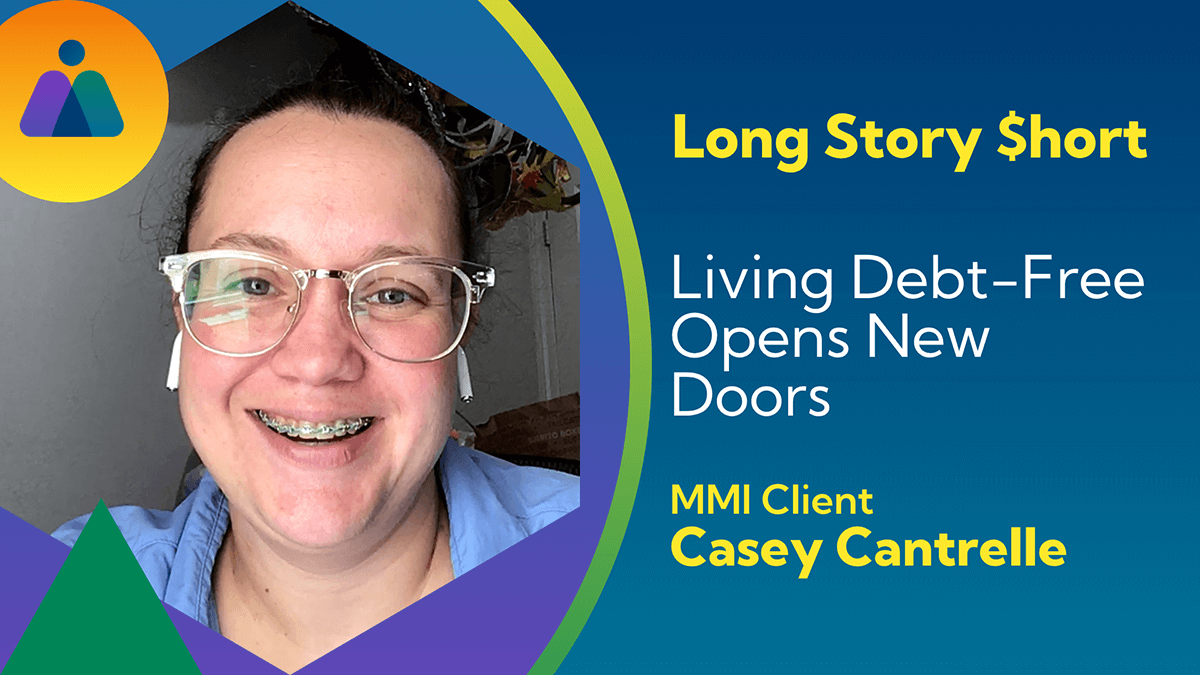
- Guest: Casey Cantrelle
- Host: Tara Alderete
- Publication Date: December 9, 2025
Highlights
- Casey talks about her life in Louisiana and her work as a Program Coordinator for Youth Enrichment in Baton Rouge.
- Casey shares how her mother’s problems with debt and her previous work with MMI led Casey to make a call that would change her life.
- Casey talks about making strategic sacrifices during her debt management plan and how she was able to accelerate her progress as a result.
- Casey shares her family’s budgeting philosophy and why her parents taxed her allowance (spoilers: it went into a college fund).
Episode Transcript
Note: Transcripts are machine-generated and may contain errors.
Tara: Hello! Today I'm talking with Casey Cantrelle from Baton Rouge, Louisiana. Casey was able to pay off about $28,000 in just four years on an MMI debt management plan. Casey's here today to tell us more about her debt payoff story. Debt. We've all heard of it. Most of us have it.
Debt seems to be an unavoidable reality of life. But what happens when it starts consuming life? Here at Money Management International, we believe that financial challenges aren't meant to be faced alone. On this podcast, we hear stories of people whose lives have been changed by MMI. Their stories are unique, personal, and inspiring. Stay tuned. We're sharing each guest's long story short.
Casey, welcome to the show.
Casey: Hi, thank you so much for having me.
Tara: Thank you so much for making the time to be here. I'm excited to talk to you today because you have great energy and a really great story and a little bit of a history with MMI. So I'm really excited to talk to you. First, before we jump in, tell us a little bit more about you.
Casey: Absolutely. So I was born in New Orleans but raised in Northeast Louisiana. It was very what you would consider a Louisiana upbringing. You had city and country, but it was a great mix of both, to be honest. I moved to Baton Rouge in 2007 when I attended Louisiana State University for my bachelor's degree and just really fell in love with this city. We're really close proximity to New Orleans, so you get to be involved in all of the New Orleans culture, but you also you have the other way going west, you have Lafayette, which is the Acadiana area. They like to call themselves Cajun country, but we kind of get the best of both worlds because we can experience all of what Louisiana has to offer within just a couple, you know, hours drive, if, if not just an hour.
So it's a great place to be in my full-time job. I work at the Baton Rouge Recreation Department here in Baton Rouge. So we service the community of East Baton Rouge Parish with all parks and recreation. And my role Marti Gras Krewe is as the Program Coordinator for Youth Enrichment, managing all programming for ages 3 to 17 in our parish. So everything from preschool programming to after school to teen night outs. Summer camp is our big one. We spend 10 weeks in the summer serving thousands of youth in our parish, just bringing them new and fun experiences that they may not otherwise get.
We also teach swimming lessons and different things like that. So it's a really fun job. Every day is different. I really get the opportunity to be a kid again. I love going on field trips during the summer. Any given week, I get to go on at least three, if not more. We ride the school bus and everything. It's awesome.
I really enjoy my job. I really enjoy what I do. And I. I'm married to my wife. We've been married three years. We have currently three dogs and a cat. We're constantly busy, but we are those dog people that go to all the dog park and Recreation events and all the things we use our dog parks.
We are a part of our community. And just really enjoy getting to spend time outdoors and just enjoying where we are, the culture, the music festivals, all the things. That's really, I mean, that's really me in a nutshell.
Tara: You're having a great time in Baton Rouge and I love it.
Casey: Yes, we do have a great time here. My wife is a transplant from New Orleans, was born and raised there, lived there her whole life, and she moved this way, and I say this way, it's all of like an hour's drive, but she's like, There's nothing to do here.
Tara: I don't understand.
Casey: And I was like, Girl, we have to really plug in and you have to see what this community has to offer. And I'm going to tell you, it's not like New Orleans, but it has its own kind of spice and zest for life. And there's always something going on. We have incredible parks and recreation system here. We have incredible libraries, community events, nonprofits that do all kinds of stuff. It's really awesome. You can always find something to do here.
Tara: Awesome. So, Casey, You first heard of MMI from your mom. Is that right?
Casey: Yes.
Tara: Could you tell us a little bit more about that and why you decided to reach out to us? Sure.
Casey: So a little backstory. My mom was a single parent. She divorced my biological father when I was about seven years old, and that relationship ended in a lot of financial difficulty. As a single parent, she really had to figure out what she was going to do for my sister and I. Not knowing at the time, obviously, how in debt she was from that relationship and financial decisions she didn't even make, honestly. She reached out to MMI and this would have been the early 90s, mid 90s. It allowed her to be a single parent and budget her funds and pay off debts and do things in a manageable way.
So I just paid off my debt. I was 35. Five, and it took me four years. So at about 30, I was sitting with about 28, 000 worth of debt. I was a teacher at the time and doing what I could to kind of make ends meet. But lots of cards, lots of payments, all the things. And I was just honestly complaining to my mom one day, and she was like, hey, you know, when I had all this trouble when you were younger, I used MMI.
Like, go ahead and give them a call, see what your options are, just. Like, really just call. There's no harm in making the call. At the end of the day, if that's not the decision you're gonna make, at least you have the information. And so that's what I did. I picked up the phone and made the call literally within like 10 minutes of getting off the phone with her. And I can honestly say that call changed my life.
I was able to really make financial decisions and financial progress that otherwise, like, would not have happened. So whether we want to admit it or not, sometimes our mothers are Right. She really hit the nail on the head with this one and helped me out in a time where I really was losing hope and like really losing steam and making progress moving forward. So I am super thankful that I was able to have my own journey with MMI. But then also like now we kind of sit down and we've talked about like what headspace she was in when those decisions were being made early on in my life. We don't necessarily have parallel stories by any means, but she was able to find a manageable plan that helped her really get a hold of everything that was going on around her while she was drowning and learning how to be a single parent and figuring out a budget and where are my kids going to school?
Are we paying for school? Are we doing, you know, public school, like all of these things. And because MMI was structured the way it was, she was actually able to pay off her debt in a timely manner and get us into private school. I started private school in the fourth grade. So from first grade to third grade, I was in the public school system, and she was paying down debt that whole time. And then she was able to move us into private school once that debt became manageable. So it was a really deep story to hear about your parents struggles, but I'm so thankful she was open about it.
And, like, really, we had that conversation, and then it led me on my own Financial Journey that really pushed me forward and has set me up for success going into my, unfortunately, mid to late 30s.
Tara: But it's, you know, it's so important. And I'm glad that you said that because, you know, I think it's definitely a topic that we should talk more openly about.
Casey: Absolutely.
Tara: And the truth is, when we do, when we do have that honest, open conversation in our homes, things really do start to change. And you are a living testament to it.
Casey: Absolutely.
Tara: But while you both, it sounds like you had a great experience with MMI and getting out of debt. We had talked a little bit about this earlier. Yes, a debt management plan is going to help tremendously and folks that can walk you through this process are going to help tremendously. But getting out of debt is work. And so there are some sacrifices that you've got to make along the way to be successful. There are some mind shifts like you talked about. So tell us a little bit more about that and what advice you would give to somebody in a similar situation.
Casey: First piece of advice that I would give anybody is make the call. Like my mom said, the worst thing that can happen is you have the information and it's not the right fit for you at that time in your life. I highly doubt that will be the case because MMI really does work with you to make a plan and a path that keeps you realistically moving forward, but at the same time, you also have to know where you're willing to really sacrifice and give up some things. So for us, I had not met my wife when I started this program, and my monthly payment was over 700 a month. It was a large chunk of money, and I purchased a house at 28. And so a lot of my credit card debt actually came from housing expenses. You know, buy the house.
They say you'll love being a homeowner. And then your air conditioner breaks, and this happens, and that happens, and you've got all the things that just kind of put you in a bind. And being relatively, I guess, I would say young at the time, late 20s, I really didn't know what to do. I had an income coming in, but I was like, I need to do this, and I need to do this now. So I just swipe a card for it. Or, you know, the fancy people come out and they're like, oh, you need these new gutters for your house. Let's set you up and we'll get you a Wells Fargo home equity credit card or whatever.
And then you realize very quickly that it's got 29% interest on it, and you're literally, like, drowning before you even make a payment. But all that to be said, like, Figuring out what you can sacrifice and where you will sacrifice is the biggest thing. I don't mind cooking at home, so we cut eating out. We eat out maybe once every other week, and we use those as like now date nights and special times to go out. And it doesn't have to be a fancy restaurant. It can just be, you know, on Yelp you have those dollar signs. We usually aim for the $2 signs or below, but it's making the choices to eat generic cereal instead of eating name brand.
It's saving those dollars at the grocery store. It's knowing where to put any extra funds. And that's where MMI really helped out in the process. When I was able to have an extra payment due to the sacrifices that we were making, it gave me the freedom and the flexibility to decide with an MMI advisor how to best put in that money to where it needed to go to help me in the long term. But yeah, the sacrifices are real. You kind of have to know what you're willing to sacrifice on. I used to love Stitch fix. You're. You would get the fun, fancy clothes in the.
In the mail and do all these things, and I would get them, like, quarterly, and that got cut out. Like, I didn't necessarily need new clothes. Like, if I needed something, I would go to, you know, like, one of the stores where you have to kind of dig to find what you needed, and it saves.
30, 40, $50 on an item of clothing. But really and truly, it's it's just understanding that you have to put in the work to make the sacrifices actually happen. Like it's not just this magical pill you can swallow and you're like, oh, I'm going to be debt free because I'm making these payments. Like, no, that's not really how it works. But in the long run, like it is totally worth it. So my advice, make the call and just know like what you're willing to sacrifice. When you kind of put your plan in place.
Tara: So what would you say is the most important thing that you learned throughout the process? Would it be that budgeting piece?
Casey: Absolutely. You know, when I was a kid, my parents had a chore chart, and every chore that we had, I I'm one of five children now in a blended family. We would pick our chores every two weeks, and based on the chore that you did, you got x amount of money. So, like, if you cook dinner, you got $5, but if you took out the trash, you got a dollar. Like, it was. It was very economically sound for my engineer father. We would pick our chores in rotation.
You would have to choose, like, from a deck of cards, the card that you wanted. And then, depending on what card you got was the order that we picked chores in. It was. It was a very, like, interesting process. And so, from a very young age, I understood the value of money. I understood having to work for what you got. And yes, my parents did tax us on our allowance.
We didn't know it at the time, but they saved all of the taxes from our life and then gave it to us when we went to college. So it was a really nice kind of bonus. And so those of us that did more chores or higher paying chores got a better payout at 18. It was just a really cool way for it to be set up and structured. But because I learned the value of money, I always knew that, like, budgeting was a thing. I never really knew. How to budget, though.
And that's where you get in the sticky situations. You have credit cards, and you're like, oh, it doesn't quite fit my budget, but I want to do this. And you're like, I'll just swipe a card for it and pay it off later. But you don't think about all of the pieces that go into that quick swipe of a card. Like, you're talking interest, and you're talking payments. And, you know, like, for heaven's sakes, like, if you're just making minimum payments, like, you're gonna be drowning really quickly because that's not. How it is structured to work. And so, you know, really understanding financially where you stand and where your money goes allows you to really see one, what you value in your world, and then two, like where you can save and where you can apply extra, or if you're actually being economical and financially responsible with your money.
And so it's really getting a very valid look at where your dollars go and like understanding how you're spending your money. And the MMI courses honestly probably taught me more than I really would have ever thought in that kind of atmosphere and environment. But it was such a good opportunity to really get a refresh and spreadsheets with dollar amounts and all of those things that auto calculate and all of that, it's not realistic. You're not going to keep up with that. Keeping envelopes of cash, that works for some people. I lose things very often. So being responsible enough, I guess, to, like, keep up with envelopes of cash was, like, not an option. And so really learning how to, like, budget dollars and knowing, like, if I can only save twenty dollars per paycheck to go into my fund account, like, where is that fun account?
Is that fun account actually gaining an interest while it's sitting there? If I'm not using it to go buy a concert ticket or go to a festival or do whatever, like, if it's just gonna sit there for a couple months, like, it might. As well grow for, you know, a couple, even if it's a couple dollars. Like, so it really opens your eyes to what your financial options are and really kind of keeps you just like, I know I say this a lot, moving forward in your financial journey, because ultimately, the goal for me is to be able to save so that I can actually retire and, like, have fun with my life and, like, not have to work 12 million hours a week. And even though I love my job, like, there's gonna come a point in time where I want to stay home or go and travel or, you know, do those things. And so being able to really put my debt away and not have to deal with it because it's paid off and I am freed from that, like, it gives me now the opportunity to save for vacations or to go on the crazy trips or ride in Mardi Gras parades or, like, do whatever. So it's a very hard process.
But it is definitely worth it.
Tara: So it sounds like in your family, you guys had a pretty good open dialogue and a pretty good handle on debt and finances and the situations. But you know, debt, it really is one of those things that is very common that few of us talk about. And so we're trying hard with this podcast and other avenues to break that stigma. And so how do you think debt counseling organizations like MMI do that? How do you think they're working to break that stigma around debt?
Casey: So I will say, especially being in the millennial generation, the world is getting expensive around us and income is not matching that. And so there are oftentimes where people are finding themselves struggling with debt because they can't cover their basic necessities. And I think honestly, the reality is, is like we know the world's not going to get cheaper. So if we can have open conversations about debt and managing debt and relieving yourself of debt, like what that feels like and how you can move forward from it, I think is the most important part. You know, word of mouth is how I learned about MMI. I tell people all the time, you have very passive conversations with with people and they're just like, oh, I'm really struggling to pay these bills or things are really tight this month. And it's very awkward to say, like, have you ever thought of a debt management plan?
But like, once you've done it, you're ready to sing its praises. And so it's being able to like step up and really have those conversations. And I think like from a standpoint of just like having this podcast and having a user friendly website and having a presence on social media, like debt management companies really, they'll never not have a reason to exist because I think people will infinitely always be in debt in some way, shape or form. But I think just like being out there and being open and having conversations is the biggest piece of that. And so the MMI Peer Advocates was something that I was like super excited about because it was an opportunity to really like elevate the platform and help out anybody that may need assistance or just have general questions. And they're like, I don't want to ask this person because it might, you know, some people have the misconception it's going to hit my credit score. Like, no, it's not.
So it's just, you know, it's having those conversations and being honest and really just brave enough, I guess, to, like, have that conversation, even though it's difficult.
Tara: Well, Casey, I'm happy that you decided to be an M&M in my peer advocate. You're an awesome advocate for the program.
Casey: Thank you.
Tara: So you've talked a little bit about, you know, retirement and enjoying your time, but Casey, you're debt free. What does being debt free mean for you?
Casey: Honestly, being debt free is more of a sigh of relief than anything. It gives you the ability to like know that the money that you're spending goes to the things that you want it to go to. Like I'm a part of a Mardi Gras Krewe and I I can pay my dues without any struggles and I can participate in events and I can, it is calendar year. We're not just like specifically at Carnival. So we, you know, I have the option to like meet people and make friends and hang out and go out and do charity events and like do all these things and not have to worry about like where am I getting the money for this tank of gas to get me to New Orleans? Like the sacrifices are still there because I think it like four years you learn habits. That's a total shift in mindset.
It's not just like oh this is a short-term solution to a problem. And so you shift your mindset and you really begin to understand like where you're spending your money, what you value, what you want to do with your money. I have a really bad obsession with Lego kits and I call it my therapy but like I can get a Lego kit if I want one. Like I don't have to scrimp and save and do all these things to have that stress-free time. And so being debt free just opens up a whole new door to really, like, living your life and not having to worry about the phone ringing because a credit card company is calling you. They're so much less spam debt free, and it's so nice.
Tara: That is definitely a perk.
Casey: Absolutely. Absolutely.
Tara: Casey, it has been so wonderful to talk to you today. Is there anything else that you'd like.
Casey: To share with I'll just reiterate my piece of advice, like make the call and get the information. That is honestly the best thing that I can say. You know, if you're struggling in some way, shape or form financially, and you do have debt that just feels like it's engulfing you or like you don't see a way out, like there is opportunity for change. It does come obviously with sacrifices and challenges, but in the long run, like it totally pays off. And the sense of accomplishment is just unbelievable when you get that, that final bank statement and it's like 100% paid. Congratulations. And so it's really, it's being informed and using your resources.
And that's exactly what MMI is. It is a resource to really get you back on your feet and give you the skills that you need to sustain your life long term. And it, it allows you to take a really unfortunate and dreadful situation and see a light at the end of the tunnel. And that's really like, that's your ultimate goal. And so it gives you that hope and that freedom to really move forward.
Tara: Awesome. Casey, again, thank you so much. It's been an absolute pleasure to get to know you and to hear your story. And I can't tell you how much I enjoyed talking to you and having you on the show today.
Casey: Absolutely. Thank you so much.
Tara: This guest is a real MMI client whose success success is the result of hard work and dedication. While MMI cannot guarantee results, taking early action can increase available options and improve long-term outcomes. Thanks for listening to this episode of Long Story Short, brought to you by Money Management International. To learn more about our work and how we're helping people in all walks of life repay debt, balance their budget, and find lasting financial peace of mind, visit moneymanagement. org.
Return to main podcast page