Show Notes
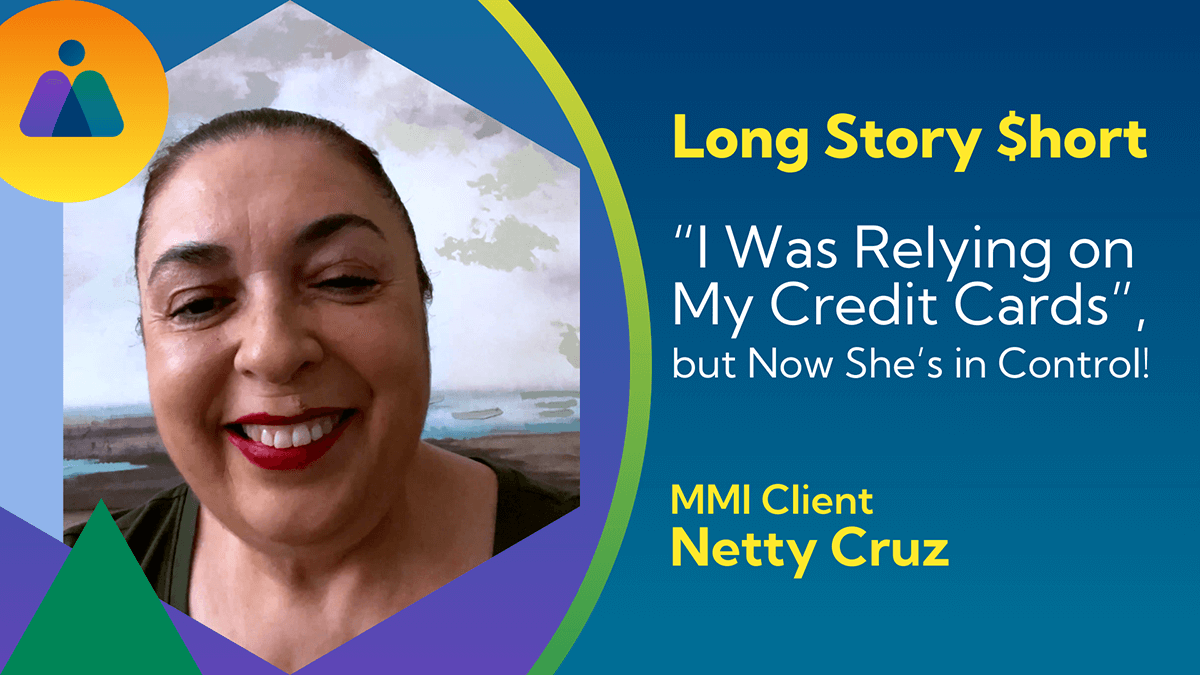
- Guest: Netty Cruz
- Host: Tara Alderete
- Publication Date: January 20, 2026
Highlights
- Netty talks about the severe accident that put her husband out of work and how the family’s debt quickly grew.
- Netty and Tara discuss the importance of having bilingual resources for heavily Spanish-speaking communities.
- Netty shares some of the tips she learned working with MMI financial counselors.
- Netty talks about how exciting it is to see your credit improve as a result of completing her DMP and paying off her debts.
Episode Transcript
Note: Transcripts are machine-generated and may contain errors.
Tara: Hello and welcome to Long Story Short. Today I'm talking with Netty Cruz from Sparks, Nevada. Netty was able to pay off $20,000 in debt on an MMI debt management plan largely because of reduced interest rates. So Netty is here today sharing her debt payoff story. Debt. We've all heard of it. Most of us have it. Debt seems to be an unavoidable reality of life. But what happens when it starts consuming life? Here at Money Management International, we believe that financial challenges aren't meant to be faced alone. On this podcast, we hear stories of people whose lives have been changed by MMI. Their stories are unique, personal, and inspiring. Stay tuned. We're sharing each guest long story. Short. Netty, welcome to the show. Hi, thank you. Before we jump in and start to talk about this $20,000 out of the way, tell us a little bit more about you. I'm a housewife
Netty: And I have two kids. Uh one is uh just graduated from college in May and is studying his masters now. And my youngest is a high school senior. And I do have a husband too
Tara: Congratulations. You're in the home stretch with your kids and it sounds like they're doing great stuff. They are. So I understand that you came to MMI in 2020, uh wait at the start of COVID. After a reduction in household income. So I was hoping you could tell us a little bit more about what was going on in 2020 and how you found us here at MMI. Okay, uh this is the thing.
Netty: Uh my husband is uh only one who was working in our household, um, because my kids were like in school and they were little, one was in elementary school and the other one was in high school. And my husband in 2019, he was working and he had a very bad accident. He fell from 15 feet. and uh he broke the reeds, for vertebrace fracture, skull fracture, um rotator calf tear. So he had a very bad accident. What happened afterwards is that in Workers Comp he was receiving just 66% of his income. So obviously I was relying on my credit cards to buy groceries and to help me pay bills and all that. So You don't really realize how much you are getting in debt when you are in need, you know? So it was super crazy And when I was receiving 66% of his income, everybody was telling me, but it's tax free. Yes, it's tax free, but my bills didn't come down 66% So I couldn't wait until we do our taxes to have a relief, you know? So that's why I started using more my my credit cards. And then in 2020 the pandemic. So it was terrible and I I I couldn't find a way out So I went to my bank and I was talking to one of the bankers and telling him, it's like, I'm desperate. What can I do? And then he referred me to MMI. And I say, you know, I had seen on TV some ads about dev relief, but I don't know if I can trust them. And the guy in the bank told me, oh my God, you can't trust MMI. So I called you guys, um, then a counselor was looking on all my deaths. And um he made a plan for me and when he told me the monthly payment, I was like, what? I don't think I can do that. But you know what happened is that in the beginning of the pandemic, all the credit card uh people were telling you, if you don't want to pay, if you can't pay, don't pay. So we will wait for you, but the interest were coming up and up and up. So when at MMI they told me the monthly payment I have to do is like, oh my gosh, it's on so much But when I realized how much I was making my monthly payments, it was almost the same amount. And the interest was very, very different. So uh I decided to take the MMI plan and I'm going to tell you the truth. It was not always easy. Sometimes I have to ask my sister or my mom to borrow me some money so I can have the monthly payment. But you can see like in a couple of months how your depth is coming like lower and lower and that really motivates me. It's like, gosh, I'm really paying up.
Tara: There's some momentum. So I hope that your husband is feeling better now. I hope that he's doing okay. That's quite a setback. And and an injury followed by COVID must have been really, really difficult. You said something about trusted resources and going to your financial institution to to learn about us here at MMI. And I wanted to ask you, you know, more and more we're seeing the importance of trusted, available resources in different communities, especially in the Spanish-speaking community. At MMI, we're we're trying. You know, we've translated our website. We provide fully bilingual counseling. But I was hoping that you could talk a little bit more about that need for trust Available resources in the Spanish-speaking community and how folks can find those trusted resources when they need them.
Netty: You know, I really think that is something that you guys should work or maybe with more Hispanic speaking like TV shows or radios or something, so more people can know about you guys because it to be honest, uh my banker was an English speaking guy. So I think Spanish speaking people need to know more about all these kind of resources that are really trustable and you know we need more information about you guys So I think that maybe you can start doing like podcast in Spanish or something like that. That may work
Tara: That is a great idea. And I think even if it's a native English speaker, going to an organization that you already have a relationship with, a trusted relationship like your bank or your credit union. And then saying, hey, here's my need is an important way to reach out. But I appreciate that because I I do know that it's a big need and we are trying very hard to meet it. Once you found your way here to MMI, what was it like working with the counselors here at MMI? Did you take advantage of bilingual counseling? What was your experience like?
Netty: It's super easy, super easy. Uh all the people is very kind, very nice. They explain you 1000 times if you need to. They explain you with apples and pears. You know, so it's it's super, super easy. So I didn't have any problems. understanding the whole thing. And even when they told me my monthly payment, I was like, what? And they told me, do you realize how much you depth? It's like No really, and they told me it's like almost twenty thousand dollars. So that's a lot. It's like, gosh, that's true, you know? So I put almost all my credit cards there. I just kept one Just in case my kids needed clothes, uh, because after you are in the program you cannot use your credit cards. That's really important to understand that you cannot use your credit cards. So I just kept one just because, you know, when you have kids in elementary and teenagers, they grow up so fast. So I was like, oh my gosh, so uh maybe I won't have any money for clothes. So I just left uh one credit card for clothes, but it was just like emergency things So what I taught my oldest son, I already taught that to my youngest too, is like to take advantage of things that the credit cards have now. Like for example, um, I told my oldest son now that when he starts driving and all that, okay, go to the gas station and let's say that you have $50 for gas. Put forty five with your credit card, but deposit fifty dollars. So you have five dollars balance for you. If you do that every time you go to charge gas, At some point after nine times you will have a free gas tank, you know? That's a dream idea And you will have the points. And now he's doing that even he was doing that even for his tuition at college. So he was paying with his credit card and getting the points, but immediately he was making the deposit and the payment. Because by my own experience, I know when you use your credit card, you feel like that that's free, you know. if you don't pay pay right away. So is it working for him?
Tara: It does. It can feel sort of like you don't see that money going out of the account right away, so it's a little bit of a different experience So you know said a couple of things. You talked about the fact that it was a successful journey but it wasn't easy, that you really had to do some some different things to be able to stay the road. But then also it sounds like you had some important conversations along this journey with your family and your kids, which I think is fantastic. So what would you say, I mean, it's so much more than paying off debt. So what would you say was the most important thing that you learned throughout the journey, this debt reduction journey and working with us here at MMI?
Netty: trying not to use my cards much and if I do as I told you I try to do the same that my uh I that I taught my kids so If I'm using my credit card for $50, I go to the bank and I put $55 on that. So that way I'm always on top of my debt now. So and I'm trying to use my mostly my debit card. So that way I can see the money coming out from my account. And I don't have that um, how do you call that? Uh like when you overdraft protection, I don't have the overdraft protection. is like if I don't have the money, don't authorize my transaction. That's it. Yeah. You know? Yes, that way, um, because sometimes you take money from your um savings and from your credit card to authorize your transaction, so I don't want that. If I don't have the money, I don't buy it. That's it
Tara: I mean it's great advice, but I think it's hard, you know, it's hard to do. But it really is about sort of uh giving every dollar a purpose and and living on that plan and and staying within your means. And so it sounds like that was an important thing that you learned throughout the journey. And again, I love that you are taking what you learned and sharing it with your kids. I think that's hugely important. So what advice would you give somebody else in your position struggling with debt about how to get out of debt, how to find those trusted resources that they need in the community, things like that? Don't wait, don't wait.
Netty: Every day uh you wait, you are wasting money So you are putting your money in the trash every single day. So you have to act as quick as possible. And make the decision. It's like, okay, I want to be debt-free now. I don't want to wait anymore. Because it's uh you're just wasting your time and your money when you wait
Tara: So don't wait, reach out as soon as possible. I love it. You know, Netty, this podcast and this conversation that we're having, which I appreciate so much. is really intended to break the stigma around debt. You know, debt is something that is common. So much of us have it, but we don't talk about it. We experience those hardships in life, like you described but we simply don't talk about it. So what do you think folks and organizations like MMI can do to help break that stigma around debt?
Netty: You know, I think you have to reach out to people like on TV ads or podcasts or whatever. And the more you talk about it, I think people will be like, you know, yes, maybe I can do that. Because sometimes that's true. You don't you feel like a shame that you owe that money but do you don't want to share that. But it's something that you don't have to be ashamed about you know, everybody at some point struggles. And, you know, I think it's really important that you know that there's someone who ha can really help you and is going to take is not going to take advantage of you.
Tara: conversation. Like I said, I appreciate you having it with us. So Netty, $20,000 you were able to pay off, which is absolutely incredible. And throughout the journey, you learned how to budget more effectively and save while you're still spending and teach lessons to your kids. So what does being debt-free mean for you? And then what is the next financial goal? you know, peace of mind.
Netty: I feel really well, you know, that it's like I don't have to be thinking how much I owe to the bank and uh watching how all that debt increases. So that's really stressful. So the peace of mind that I'm debt free I right now I'm thinking like maybe I will be able to buy like a car like in a couple of years. So I'm trying to save a little bit by a little bit. So instead of putting the money to the bank, I'm trying to put that money into my own account and maybe be able to buy a car in a couple of years.
Tara: Wonderful. I love it. So it's it's enabling you to reach those bigger financial goals and you set it. Peace of mind. You know, you you feel just so much more at ease and comfortable with whatever life sends your way Netty, I appreciate you so much sharing your story and talking to us and your perspective. Is there anything else that you'd like to share with us today?
Netty: Yes, one more thing about your credit report. Being debt-free and all that helps your credit report a lot too. So I was kind of scared that, you know, with all the debt my credit because I I used to have a very good credit and I was like after all that debt I was like oh my god my what is going to happen with my credit report But in my experience, when you are like in a program like MMI, even the Credit Bureau really appreciates that you are doing that. So it you don't have any bad reports in your credit um report when you pay up your debt So I think that's good because you are not like bankruptcy or anything like that. So you when you are debt-free, mm, MMI reports that you pay off all your debts and that's it So it's a new fresh start.
Tara: Oh, I love it. A new fresh start. And you know what? I'm glad you said that because credit it does. It affects us in so many ways. So even after you achieve this huge goal and you're able to squash this twenty thousand dollars in debt, it's important to keep on checking your credit, making sure you know what's on there and everything is accurate and good. And so for folks listening, if you're interested in doing that, you can go to annualcreditreport. com and get your credit report for free. So Netty, thank you so much for bringing that up. It's a hugely important thing that I didn't even I didn't even think about asking you about. I appreciate it. And I appreciate you taking the time so much to talk to us today. Thank you again for joining us. This guest is a real MMI client whose success is the result of hard work and dedication While MMI cannot guarantee results, taking early action can increase available options and improve long-term outcomes. Thanks for listening to this episode of Long Story Short, brought to you by Money Management International. To learn more about our work and how we're helping people in all walks of life repay debt, balance their budget, and find lasting financial peace of mind, visit moneymanagement. org.
Return to main podcast page