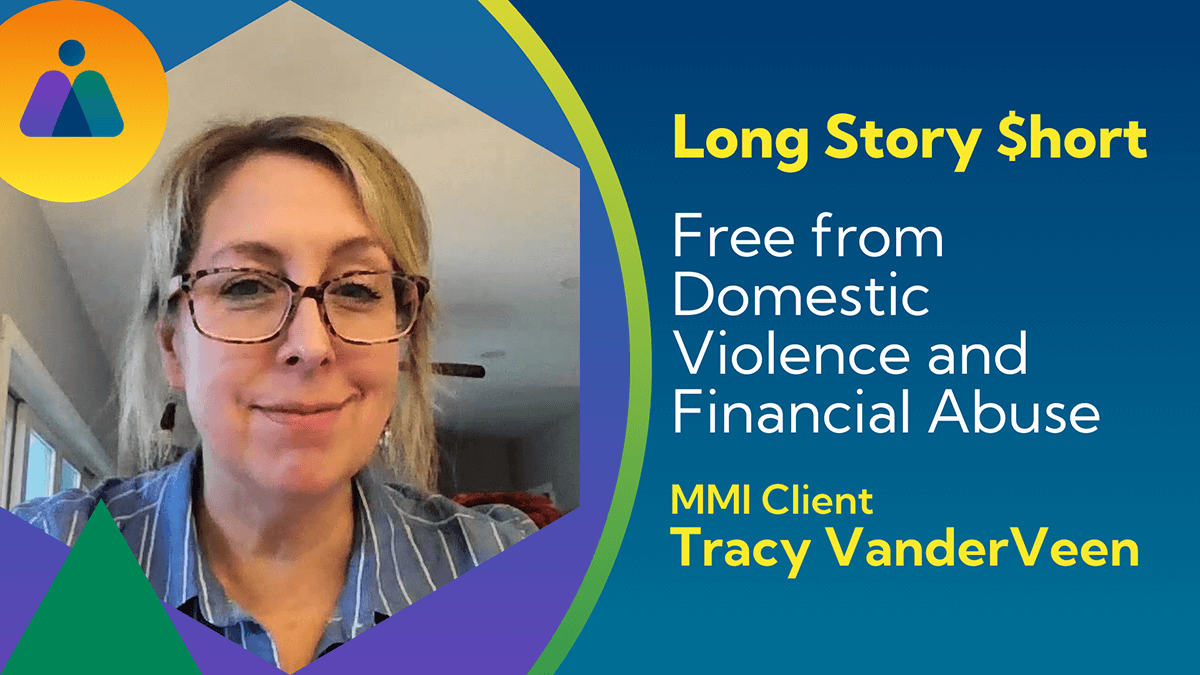
Show Notes
- Guest: Tracy VanderVeen
- Host: Tara Alderete
- Publication Date: January 6, 2026
Highlights
- Tracy talks about the expensive divorce that ultimately led to her house being foreclosed.
- Tracy talks about how a later relationship turned into a nearly decade-long nightmare of physical and financial abuse that left her badly in debt.
- Tracy shares the story of how a coworker told her about MMI.
- Tracy talks about how easy it was to work with MMI and start her personalized debt management plan.
- Tracy explores her family history with personal finances and how she came to develop her financial belief system.
Episode Transcript
Note: Transcripts are machine-generated and may contain errors.
Tara: Hi, thank you for joining us. Today I'm talking with Tracy VanderVeen from DeLansyn, New York. Tracy paid off about $30,000 in debt in about five years, and one of the big deals was reducing interest rates to about 11%. So Tracy is here to share her debt-free journey with us today.
We've all heard of it. Most of us have it. Debt seems to be an unavoidable reality of life. But what happens when it starts consuming life? Here at Money Management International, we believe that financial challenges aren't meant to be faced alone. On this podcast, we hear stories of people whose lives have been changed by MMI. Their stories are unique, personal, and inspiring. Stay tuned. We're sharing each guest's long story, short.
Tracy, welcome to the show.
Tracy: Hi, thank you.
Tara: I'm really glad that you're here with us, so thank you so much for taking the time. Before we jump in, could you just tell us a little bit more about yourself?
Tracy: I'm a home care nurse. Which is a wild and exciting world. So I live in upstate New York. I am recently married a couple of years ago and inherited a son. I have two daughters of my own and I have two golden retrievers who we were just discussing. We hope we don't see them zooming past us in the background. We just built a house.
That's another exciting thing that the debt management program actually allowed me to pay off debt and save enough money so that we built a home. So that was finished in June. Just a lot of exciting things in my life right now.
Tara: That is very exciting. Thank you for sharing that. I was hoping that you could take us through what brought you to MMI, what was going on at the time, and how you found us.
Tracy: The long and short of it, and I think a lot of us have a story like this, is I was a single parent for about 20 years. And during that time after my divorce, I initially accumulated debt because of the divorce, which I think anyone does regardless of their circumstances, lost my home to foreclosure. And in the midst, I met a partner and ended up in a very severe domestic violence situation, which lasted about seven years and took me about three years to get out permanently and away. And during that time, the legal fees that I incurred to get away from my abuser were extensive. And forced me into taking a personal loan at a very high interest rate because I had poor credit to begin with. So financial abuse is something no one ever talks about, let alone debt management.
So I've had quite the journey. That journey alone was a decade of my life. So really from the age of 30 to 40. And then after resolving that issue and getting free from that and healing from trauma, et cetera, et cetera, I started to rebuild. And so really my story is a ground zero rebuild. So lost my home, lost my children for a time. It was pretty traumatic and devastating.
However, what came out of it was clearly a good life. So 10 years later, I'm in a completely different situation. Where MMI comes in is I was sitting in front of one of my fellow nurses in the office and she was on the phone. She said, I'm going to be on this call for like a half an hour, so I have to talk to a counselor. And I thought it was like a mental health counselor or whatever. And she got off and I said, Is everything okay? And she said, yeah, I was talking to Money Management International and I was talking to a counselor because I'm in a lot of debt.
And she goes, I don't talk about it, but it is affecting my marriage. It's affecting my life, you know, from one end to the other. So we got talking and she was really excited. In the weeks after that, she got her payment plan. She kind of showed me her breakdown, which she was very transparent with me and very open, which helped me. And I said, you know what? I'm just gonna give them a call.
So I did research the company online. I called and spoke to a counselor about an hour, and it was pretty straightforward. I mean, we looked at what I had. We talked about where I wanted to be. We talked about what kind of monthly payment that I could afford. And the relief that came from having one payment and knowing that all the rest of it was taken care of, meaning that I made one payment and MMI then distributed that money and allocated it, however they saw fit. I couldn't tell you, I wanna say it was pretty even, except they hit the one with the highest interest rate, the hardest first.
I might be saying that wrong. But I, they talked me down. I mean, some of these interest rates on, let's say like a Kohl's card because I needed to buy clothes for work. That was like 27% interest. I mean, it was extensive. So I was making my monthly payments, but when you are only making the monthly payment, because that's all the dollars that you have to give to debt, you're looking at 25 years. So I'm like, wow.
And then when they showed me, one of the most motivating things for me is the monthly statement, right? So it comes and they show you a little pie graph. Pie graph, and I'm a goal-oriented person. So when I saw that pie graph, you know, okay, I'm at 20%, I'm at 30%, hey, I got a bonus at work and it's 500 bucks, and I'm going to throw that. And I was like, oh, yes, I'm a goal line girl, and it was very motivating.
Tara: First of all, that's quite a story, and thank you for sharing it. That's a pretty personal journey, and I think it's important that you shared it. And you said something about financial abuse, and you said it's not something that people typically talk about it, and I think I think you're right. And so tell us briefly what you mean by financial abuse.
Tracy: In my healing journey, once you become aware of abuse, you see it kind of everywhere. As a nurse, I've seen it in my almost 20-year career. And financial abuse is one of those things that it's a tactic. All abuse is about power and control. So whether it's a little bit of abuse, It's kind of abusive.
Tara: It might not be abusive.
Tracy: You know, people go through this. Is this really abuse? When someone uses money withholds money or threatens to take something from you, whether it's a home, a vehicle, mine was extensive. We could talk about it all day. We don't need the details. But the bottom line is that in, especially in any domestic situation where you are in a relationship with someone, whether it be a parent, Caregiver, a spouse, a boyfriend, a girlfriend, abuse doesn't discriminate. There's all along the age lines from infants all the way to very old people.
And for me personally, it was a threat that if I left the relationship, X, Y, and Z would happen. And one of the X, Y, and Z things was that the abuser would bankrupt me with legal fees, would file petition after petition after petition. So using the court system as a scare tactic. And it worked. So it worked for a very long time until it didn't work.
But it can come in so many forms. I see it happen in my nursing career as a home care nurse. I take care of people clearly in their own environment. And I am dealing with people sometimes who are at the end stages of their lives and they, you know, give their rights over to a family member who is trusted. And that family member then denies care in order for the money not to be spent.
That's financial abuse. Oh, goodness. We can really dig into it. It's a deep well.
Tara: I appreciate you sharing it. And I know it's not really off topic, but a little off topic. But the point of this podcast is really sort of breaking stigma and really breaking stigma about debt. But when you bring something up that I think is a really important topic that there is a big stigma around and people just simply don't talk about is important to share. So I appreciate it. And I think it's important for folks to know that regardless of how you got where you are or what kind of help you need or how hopeless it might feel. It's not there are resources and services and folks out there to help you.
And sometimes it takes, like you said, you know, just sort of overhear a conversation and then talk to your friend and you hear about a resource that you never even knew existed. So thank you for that. So you came to MMI, you found us, you got here.
What was it like to work with.
Tracy: The counselors at MMI to get out of that debt? Oh, super easy.
It was really easy. At first I was like, oh man, you know, you, there's an embarrassment factor. I don't think I've ever really met someone who was proud to say that they were in debt. Right. And there are times when I, in my single mom life, where I had to make a decision between putting food on the table or paying my mortgage. And eventually I lost my house to foreclosure because I could not, I exhausted all my resources. I worked two or three jobs at a time.
So I think so many people have those struggles. And for me, it was super easy to just get on the phone. I had, like I said, I think it was a 45 minute or an hour conversation. And it was, okay, let me look at this. Let me set this up. The communication back and forth was very easy.
I got DocuSign documents. So clearly I could sign them from anywhere at any time. And I was motivated myself to make additional payments just because I saw how much they affected things. And I could call and ask questions anytime. Sometimes, you know, you hate calling any 1-800 number is like, oh, please God, I need three years of my life to get through this. But it wasn't like that. I was able to get someone on the phone quickly.
There was never an issue. I was very grateful for the communication, the timeliness, the follow through.
Tara: I overall had a very positive experience.
Tracy: I love it.
Tara: And you said, you know, I got partway through this journey and saw some success and started building some momentum and put extra dollars toward it. So I love that. What advice would you give somebody else that is struggling financially or with debt or in any way?
Tracy: A lot of these topics are pretty universal in the sense that when we are beaten down or feel defeated, we feel very isolated. And it's like a vicious cycle, right? The isolation then brings anxiety, it brings depression, and then we aren't motivated. So it's kind of like exercising, right? Like in the beginning of the year, we're all like, yes, I'm going to do this every day. And then by week two, you're like, okay, I can't. So this is the way, actually, one of my therapists described this to me.
It takes going from this to going to this, right? So we're opening up our view and we're seeing more than just ourselves. And I think simple conversations with people that you trust are probably the biggest Treasures, because once people are brave enough to just say, hey, this is where I'm at, regardless of how it looks or how it feels to somebody else, it can be. I mean, that's. And that is a statement I think that we can make on so many platforms, whether it's Prejudice or, or politics or whatever we're going to talk about, it's just opening up our eyes and looking at the world. Instead of this little mouse view and saying, hey, I need help on some level, I'm willing to do the work. Now, this is another thing.
I'm a big believer of, if we're going to ask for help, we have to be willing to move our feet. So this is not just click the button and my debt goes away. It's a process, it's a commitment. And that's true in so many other things, whether it's escaping from domestic violence or losing 20 pounds or whatever the deal is, it takes action on your part and a level of commitment. And when you see the numbers start to go down, it's inspirational. So you want to do more. Just like when you see the scale start to drop, you want to do more.
Tara: And I love what you said about just sometimes it comes down to or it starts with having a candid conversation with somebody that you trust. You sort of mentioned this. This is a journey and it requires some work. As much as we would love to press the button and have our debt be gone, it just doesn't it doesn't work that way. So what would you say is the most important thing you learned throughout the journey?
Tracy: Restraint. It was. Okay, so this gets real.
We could get really deep. We could talk about this for hours, but I'm. I'm so passionate about it just because I've experienced it on so many levels. The change that happens when the stress comes off and, you know, hey, like, my payment, I I want to recall, maybe it was like 600 and some dollars a month. That money had to be paid. I looked at that as untouchable money. And I started to explore my relationship with money, which sounds really strange, but it's a thing.
It's a thing. We have triggers, we have patterns. I went as far as researching how my relationship with money began. And one of the exercises that I found was super helpful is to recall my first experience with money. And I was thinking, how am I going to remember that? Well, I remembered it in an instant. I remembered two things.
And what I discovered is that my parents were very poor. And not that I discovered that, but what I discovered is that I had a negative view of money. We never had it. My mother would constantly, as much as I love her, she would constantly say, we can't afford that. And I would go to school without the things that the other kids had. We go on and on and on and on and on. I'm sure that's also true for people that have an excess of money.
There's a relationship there. Maybe it's not valued as much. Maybe it's not appreciated as much. So once I discovered my relationship with money, it's oddly similar to your relationship with people or your ability to accept love. I mean, I'm telling you, I've got hours to talk about this. However, I think the bottom line is I became very aware and then I held myself accountable and then I would restrain myself. So when I was having a bad day, whether it be PTSD or work was bad or whatever the deal was, I learned to sit in that uncomfortable space, not trying to fix it, not trying to put a Band-Aid on it, not clicking the button on Amazon.
I need that. I need that. I need that. Not opening another credit card. I did not open another credit card for probably three years into the program. And I got offers all the time, but I wouldn't do it. I decided that if I had the money to purchase something, then that's when I would purchase it, unless it was an emergency.
And I didn't even, the funny thing is, in my financial journey personally, I didn't focus on saving. I focused on paying off the debt first. I wanted the weight of the debt completely gone. A lot of people say that they approach it like, okay, I'm gonna put this much toward debt and this much toward savings. I personally did not do that because I did not have the funds to do it. But yeah, I think restraint is probably that was the first thing that came to my mind. That's the work you have to put in is become very self-aware, being very honest with yourself about how you spend.
Tara: Yeah. So, you know, the next thing I like to ask is the point of this podcast and the conversations we have are really to break the stigma around debt. But you've said so many important and insightful things that I think it's important to break stigma around. And so how do you think folks can do that? Just sort of work to break the stigma around debt and financial abuse and your relationship with money and talking about money. How can they do that?
Tracy: I don't know if there's a blanket answer, but I do think that if you really start to pay attention, there are so many resources and there are so many people willing to talk about it. So it really is kind of like anything else. If you want to learn anything, you have to go outside of yourself and find an expert or someone who has had experience. I'm a person that.
How do I say this? It's kind of like work. It's really difficult for me to take direction from anyone who hasn't walked in my shoes. Like, if you don't know how to do the job that I'm. You're asking me to do, I have a hard time respecting you. So for me personally, I seek out people. Or experiences or podcasts or YouTube videos or books from people that have a very personal story to tell and then can show me the outcome.
So Susie Ormond, am I saying her name right? Like financial guru. There are stories like that. There are stories like the woman who wrote Harry Potter. I mean, she was on welfare when she started her journey. There are so many people that come from rock bottom and work their way out. And I like to hear those stories.
Now, there are stories of people who just opened credit card after credit card after credit card, and, you know, they are really in a place because they couldn't control their spending. And why couldn't they control their spending? It needs to go down the rabbit hole. But I think the simplest way to say it is just talking about it and then in, in devoting some time to researching it.
Tara: Whatever's personal to you.
Tracy: And really, I have a little bit more insight just because of the years of trauma therapy and what I started to discover. All these things are interconnected, right? How did I allow myself to get into such a debt? How did I allow myself to stay in an abusive relationship? These are things that are very personal, but if you keep your eyes closed and you're hid like this, you're not going to get out. So it really just takes a little courage and a little faith in yourself to be able to say, okay, I'm open to hearing this. I'm open to exploring this.
And the key is awareness. Once we become aware, real people say, oh, it's going to be such hard work. It's going to be so much work.
I can't do it. I can't do it. And what I've learned is that as soon as you become aware, whether it's overeating too many M&Ms or driving too fast or shopping too much or whatever it is, Once you become aware of it, everything else falls into place. Yep.
Tara: I think that was perfectly said. Tracy, you have had quite a journey, and this conversation has been so good and so important. I want to ask you, $30,000 down is incredible. All the other stuff you overcame in the process is incredible.
Tracy: So I've listened to your story of, I mean, it's really a story I feel like of hope and perseverance and I love it.
Tara: What does being debt free mean for you?
Tracy: Well, that's a funny question because I'm not debt free anymore, but here's the really cool thing, right? So I became debt free other than my car payment and my husband and I, when we came together, He was two years out of a divorce and he's 10 years younger than I am.
And he had a $80,000 truck he overspent on that. And when he finally started to see me, when I opened up about my finances and said, Hey, I'm at the tail end of paying off a lot of debt. And then he said, well, how did you do that? And I had no idea he had debt. So I discovered after talking with my husband and he became very open with me because he wasn't, he was I think very embarrassed about it. He makes very good money. He's a union steam fitter.
I mean, it's just that he mismanaged his money, just as I had, but just because of different reasons. And anyway, when he became open with me, I said, let's just, I literally said, and I put the whole dining room table at my apartment. I said, all out on the table. And we looked at it and I was like, okay. He goes, I'm never going to get out of this. So how are we gonna come together? And I said, don't worry about it.
So I gave him the number. I said, make some time after work tomorrow and call MMI and just start a conversation. And after 45 minutes or an hour, he came out with a big smile and he said, oh, my gosh, like, we have a plan. I can totally do this. And at the time, he was paying a thousand dollars a month for his truck. And I was like, what? First of all, we're getting rid of the truck.
Open up some dollars here because that's really not, it's not even what you need for your job. So let's talk about that. So as he became more comfortable and not embarrassed, he was able to then say, Hey, I don't have to prove myself with an $80,000 truck.
I can go with a $30,000 truck. So all these conversations started to happen. He started his debt repayment plan. And then the funny thing is, is.
Tara: Because he's in the union and he.
Tracy: Talks all day with his buddies, like five other people called MMI. Like five other people. I mean, if there was a referral program, I probably would be out of debt now. So, you know, it was exciting and everybody got jacked up and they all started to feel a bit better. All of their credit card debt was consolidated into one payment.
And Ben is about 25% paid off. And the only reason he's not more is because we went, you know, $350,000 in debt to build our house. But here's the best part, which you didn't even ask this question, but I'll tell you anyway. So I was so inspired. I went on Etsy and I bought a spreadsheet for six bucks. I hate spreadsheets. I want nothing to do with spreadsheets.
But I took half a day. I inputted all of our information.
This is an amazing spreadsheet. I put in this is stuff I learned because I was in the debt management program. I put everything in interest rates that we owed. And I am happy to say that if we use a snowball debt repayment, I don't know what we would call that strategy. There's a couple different strategies.
We will be debt free by 2033. It's like a commercial. So that's our new thing, debt free by 2033. So I went back into debt, but happily into debt to create the life that I wanted. So now when I do go into debt, it's because it's something that I truly want or need, and I have a plan to repay it so there's no more blind spending. So I'm all about spreadsheets now. I'm all about being very aware of my money.
I have a really good relationship with money now, and I can honestly say that if I hadn't overheard my friend Anita talking behind me at work, I probably would not be where I am.
Tara: I love it so much, and I feel like there are going to be a lot of people out there that say, if I hadn't heard Tracy talking about what she went through and how she got out the other side, then I wouldn't be here, too. So I think you are doing an excellent job of sort of spreading the word and breaking the stigma and paying it forward in a way. So I appreciate it so much. Anything else that you'd like to share with us?
Tracy: I want people to understand, if anybody, even if only one person hears this, it's just the same way I talk about domestic violence. If. If my story in some way can help one person, then I feel good about it. Luckily, I have the gift of gab and I tell everybody and it has inspired numerous other, I would say probably seven or eight people that I know of or through me have now joined the program and then become more financially responsible, which is good.
Tara: That is wonderful. Thank you so much. You do have the gift of gab. I loved talking to you today. Good. Thank you so very much.
Tracy: I'm a singer by trade, so I'm used to performing the kid of no no problem talking to people. Wow. Yes. Yep. So another piece of the journey. But I think we've all got something to bring to the table. And I just think that even when things feel very overwhelming in times right now are especially tough, there is a way out.
But it really does take awareness and accountability and the willingness to move your feet. Other than that, you're good to go. You can do it. You know, you can do it.
Tara: Thank you, Tracy.
Tracy: You're welcome.
Tara: This guest is a real MMI client whose success is a result of hard work and dedication. While MMI cannot guarantee results, taking early action can increase available options and improve long-term outcomes. Thanks for listening to this episode of Long Story Short brought to you by Money Management International. To learn more about our work and how we're helping people in all walks of life repay debt, balance their budget, and find lasting financial peace of mind, visit moneymanagement. org.
Return to main podcast page