

How to Beat Algorithmic Pricing and Stop Overpaying

Historically, the price of goods and services has been determined primarily by the answers to these four questions:
- "What did it cost to make?"
- "How many people want what we're selling?"
- "What are our competitors charging?"
- "What kind of profit do we want to make?"
The result was typically a single price for all consumers at any one moment in time.
Thanks to the rise of AI and increasing availability of consumer data, now there's another pricing question businesses can ask:
- "How much are YOU personally willing to pay for this?"
While the idea that prices can fluctuate at any moment based on how much consumers might be willing to pay for something isn't new, the ability to closely track your unique tendencies and craft a price that's specific for you adds a new wrinkle for anyone just trying to get the best price possible.
These models are only going to get more sophisticated, so if you're interested in finding the lowest price, the solution may be less about where you shop and more about when and how you shop.
If high prices are making it feel impossible to get a handle on your credit card payments, MMI can help. We can help you create a customized debt solution that saves you money through reduced interest rates. Get an instant estimate and see how much you can save.
How does algorithmic pricing work?
Pricing algorithms can analyze an enormous variety of data points to determine the "best" (aka, the most profitable) price for a product or service. These data points can include:
- Consumer demand: How many people are currently interested in a product.
- Inventory levels: How much of a product is available.
- Competitor pricing: What other businesses are charging for comparable products.
- Timing: Time of day, day of the week, seasonality, and upcoming events.
- Geographic location: Where a consumer lives or is shopping.
- Purchase history: What a consumer has previously purchased and how much they've spent.
- Browsing behavior: Products viewed, search history, and other online interactions.
- Consumer characteristics: Actual or inferred information about a consumer's income, preferences, and price sensitivity.
Not every pricing algorithm uses personal information. Some simply respond to changes in market conditions.
"Algorithmic pricing" is actually an umbrella term that covers a variety of different pricing models.
Types of algorithmic pricing
| Pricing strategy | How it works | Example |
|---|---|---|
| Dynamic pricing | Prices fluctuate based on market conditions. | Hotel rates increase during a holiday weekend. |
| Surge pricing | Prices increase during periods of exceptionally high demand. | A rideshare becomes more expensive after a concert. |
| Competitive pricing | Prices automatically adjust in response to competitors. | An online retailer matches another retailer's sale price. |
| Personalized pricing | Prices or discounts are tailored to an individual or consumer segment. | Two shoppers receive different offers for the same item. |
| Surveillance pricing | Personal and behavioral data is used to inform individualized pricing or offers. | A retailer uses browsing or purchase history to estimate a shopper's willingness to pay. |
The first three types are nothing new. It's personalized and surveillance pricing in particular that's worrying for consumers, because they have the potential to put shoppers at a major disadvantage.
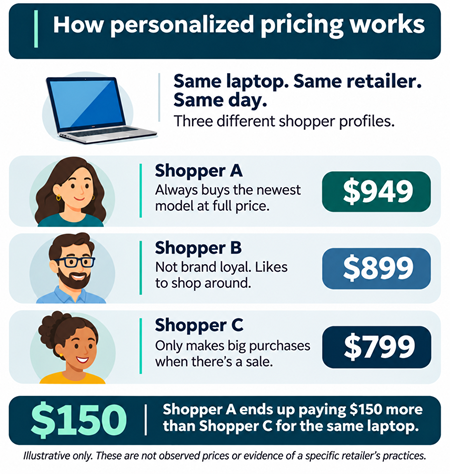
If a brand knows that you're extremely loyal to that brand and its products, it may charge you more than other shoppers, because the algorithm calculates that you'd be willing to pay a higher price.
At the other end of the spectrum, if historical data shows that you're very unlikely to buy certain products at full price, the algorithm may suggest offering that item to you at a discount.
These algorithms aren't just limited to tracking what you buy, though. In January 2025, the Federal Trade Commission (FTC) released preliminary findings from its investigation into surveillance pricing. They found that:
- Pricing technology can track your mouse movements and knows when you've abandoned a virtual shopping cart.
- Algorithms are frequently being used to determine which consumers receive promotional discounts.
- Retailers can potentially rearrange search results to show more expensive products to certain shoppers.
The more data that can be fed into these algorithms, the more personalized your offers and prices will be, and that's not likely to be in your favor.
Where is algorithmic pricing being used today?
Algorithmic pricing is already well established in certain industries, but it's growing rapidly and starting to be used in more and more places.
| Industry | How algorithmic pricing is being used |
|---|---|
| Airlines | Ticket prices fluctuate based on demand, seat availability, travel dates and competing fares. |
| Hotels and vacation rentals | Room rates change based on occupancy, local events, seasonality, and booking windows. |
| Rideshare services | Fares fluctuate based on driver availability, passenger demand, and location. |
| Online retail | Prices adjust based on inventory, competitors, demand, and promotional strategies. |
| Grocery stores | Retailers use algorithms to manage markdowns and create personalized coupons and promotions. |
| Food and grocery delivery | Algorithms can influence item prices, delivery charges, and promotional offers. |
| Entertainment and sporting events | Ticket prices fluctuate based on popularity, demand, and availability. |
| Rental housing | Property managers use pricing software to recommend rents based on occupancy and market conditions. |
| Car rentals | Daily rental rates fluctuate based on local demand, availability, and reservation dates. |
Why algorithmic pricing could be bad for you and your wallet
Algorithmic pricing isn't inherently bad. In a perfect world, it could be used to help businesses reduce waste, offer well-timed discounts when demand is low, and give price-conscious consumers access to more affordable products. However, at the moment, there are quite a few reasons why consumers should be wary.
- It makes comparison shopping way more difficult. The price you see in the morning may have changed by the afternoon.
- Loyalty may be penalized rather than rewarded. If a business is confident that you're unlikely to shop somewhere else, it's not going to go out of its way to offer you discounts.
- Your desperation could be used against you. Consumers who urgently need things like a rideshare or a hotel room may be stuck paying higher prices.
- Discounts may become increasingly misleading. A 20% discount is practically meaningless if the base price keeps changing.
- Price steering may become more common. A retailer doesn't necessarily have to raise prices to get you to spend more. It can simply make cheaper options harder to find.
Ultimately, the more businesses know about you, the bigger your disadvantage. Even something seemingly positive, like a personalized discount, can be problematic if it leads you to spend money you otherwise wouldn't have spent.
How to change your spending to beat the algorithms
Spoilers: you can't really outsmart the algorithms, so that shouldn't be the goal. Instead, your goal should be to limit the control that any one individual retailer or business has over you and what you pay.
1. Always comparison shop
Don't just buy everything from your preferred retailer, even if that retailer has historically offered the lowest prices. Compare multiple retailers before making purchases, particularly for expensive items and recurring household necessities. Don't forget to include shipping, service fees, and other charges in your comparisons.
2. Track prices, not discounts
Discounts can sound really impressive and exciting, but a discount is only meaningful if the resulting price is actually competitive.
Price-tracking websites and browser tools, like CamelCamelCamel and Keepa, can help you understand how a product's price has changed over time.
3. Set your own price before shopping
Rather than allowing a retailer to tell you what it thinks you should pay, decide in advance what you're willing to spend. Set price alerts where possible and wait for products to reach your predetermined spending limit before making the purchase.
4. Be less loyal to brands and retailers
You can love a brand, but you should avoid being overtly loyal to any brand, retailer, and business. Price algorithms can often to identify consumers who aren't willing to switch brands and that can cost you.
Be willing to purchase generic products, visit competing stores, cancel subscriptions, and try alternative service providers. Even without personalized pricing, this is just a generally smart way to reduce spend less money.
5. Shop during periods of lower demand
One of the easiest ways to benefit from dynamic pricing is to make purchases when fewer people are competing for the same products and services. That can be tough (when demand is high, it's usually high for a reason), but not getting caught up in a surge can save you a ton of cash.
Try traveling during the off-season, using public transportation instead of a rideshare during peak hours, and purchasing seasonal merchandise after demand has gone down.
6. Compare prices while logged in and logged out
Before making a significant online purchase, check the price both as a registered customer and as a guest.
Your account may provide access to valuable discounts, but it also gives the retailer more information about your spending habits. Consider using a different device or incognito mode to make yourself slightly more anonymous.
7. Reduce unnecessary online tracking
You can limit some of the information available to pricing algorithms by:
- Declining unnecessary tracking cookies
- Restricting location permissions for shopping apps
- Opting out of personalized advertising
- Using browsers with enhanced tracking protection
- Exercising applicable rights to opt out of personal data sales and sharing
- Avoiding unnecessary shopping apps and accounts
These steps can help improve privacy, although there's no guarantee that they'll help you get lower prices.
8. Compare different purchasing channels
Don't assume a retailer offers the same price everywhere. Compare their mobile app, desktop website, physical store, and third-party marketplaces. For food delivery and travel, check whether purchasing directly from the provider is cheaper.
9. Don't just blindly sign up for loyalty programs
Loyalty programs can get you some great deals, but they also give businesses detailed information about your purchasing habits.
Before you sign up, make sure that the program actually lowers your overall expenses. Compare the discounted loyalty price with prices at competing retailers, rather than simply comparing it with the advertised regular price.
10. Don't get pushed into moving too fast
Countdown clocks, low-stock warnings, limited-time discounts, and messages like "94 shoppers have this item in their cart" are intended to encourage you to make a purchase before looking at any alternatives.
Build a waiting period into nonessential purchases and be firm. Even a 24-hour delay can reduce impulsive spending and give you time to assess whether the price is competitive.
11. Build flexibility into your budget
Financial flexibility is one of the strongest defenses against dynamic pricing. An emergency fund helps you avoid making purchases out of desperation. Buying in bulk and keeping a modest supply of frequently used household essentials saves you from overpaying during periods when prices spike.
The less urgently you need to make a purchase, the more control you have over what you pay.
12. Take advantage of price-matching and price-adjustment policies
Some retailers will match a competitor's price or refund the difference if an item becomes cheaper within a specified period after purchase.
Save receipts and screenshots of advertised prices and continue monitoring the price of major purchases during the adjustment or return window.
Can you trick pricing algorithms into giving you a lower price?
If algorithms use your data to serve you the maximum price they think you'll pay, you might wonder, "Could I just change my data and trick the algorithms?"
The short answer is ...not really. At the end of the day, these algorithms are getting more complex by the day, and any counter-measures you can take will eventually lead to a counter to your counter.
But that hasn't stopped people from suggesting ways to change your digital footprint to potentially circumvent these algorithms. Some of these ideas might be temporarily useful, but ultimately none of its been proven.
| Tactic | How useful is it? |
|---|---|
| Shopping in incognito mode | Worth comparing, but it doesn't actually make you anonymous. |
| Clearing your cookies | May reduce some tracking, but retailers have other ways to recognize consumers. |
| Using a VPN | May show you geographic pricing differences, but can it can also create issues with currency, eligibility, and other complications. |
| Leaving items in your shopping cart | Some retailers send abandoned-cart discounts, but there's no guarantee that'll work. |
| Shopping from a different device | It's worth testing for large purchases, but again there's no guarantee that there'll be any difference. |
| Booking flights on a particular day of the week | Sadly, there's no universally cheapest booking day. |
Be extremely wary of anyone promising a foolproof way to beat pricing algorithms. These systems are constantly evolving and one algorithm isn't necessarily using the same data or decision-making processes as another.
At the end of the day, the best defense against algorithmic pricing is the ability and willingness to walk away from a purchase. If you have alternatives, time to compare prices, and the financial flexibility to wait, you're less vulnerable to a business trying to maximize their profit at the expense of your wallet.
If you need help balancing these high prices, MMI offers free financial counseling. Together, we'll review your debts, income, and expenses, and help you create a budget that fits your needs. Counseling is available 24/7, online and over the phone. All you need to bring is some basic financial information (estimates work just fine) and a few minutes of your time. Get started online.