

How to (Safely) Use AI to Improve Your Finances

When it comes to debt and the American consumer, we can probably agree on at least two things:
- Consumers are carrying a ton of debt
- People do not like to talk each other about debt and personal finance
Enter AI.
If your finances are poor and you need help, but shame or stigma make talking to another person unappealing, that’s seemingly where AI can step in. And it has, in a major way.
A 2025 Credit Karma survey found that two-thirds of Americans (66%) have used generative AI to get financial advice. And of those who have used AI for financial advice, 75% admit that they use AI because they’re too embarrassed or uncomfortable to talk to someone else.
Luckily, AI is really good at explaining complicated financial topics, performing calculations, suggesting step-by-step strategies, and making users feel validated and not judged throughout the process. So if you can’t or won’t talk to someone, AI can provide helpful support.
Unfortunately, AI can also be wrong. It may be working from outdated or incorrect information. It may suggest solutions that aren’t appropriate for your situation. It may just outright make stuff up.
That’s why it’s important to understand the limitations of AI before asking it to invest your life savings.
What kind of financial advice is AI good at providing?
AI is most useful as a financial education and planning tool. Broadly, it can help you understand your options, organize financial information, and explore possible solutions before making a decision.
Some of the safest and best ways to use AI to help your finances include:
Creating or updating a household budget
AI is pretty great at building a budget based on your debts, income, expenses, and financial goals.
You can provide general information about how much you earn and spend (more on why you need to keep this general later), then ask AI to recommend a budget that helps you cover essential expenses while saving money or paying down debt.
AI can quickly organize these expenses into categories, identify areas where you might be able to make cuts, and suggest some best uses for the remaining money.
It can also help you develop a budget for irregular income, plan for annual expenses, or reduce spending during periods of unemployment.
Just keep in mind that AI may not know the cost of living in your area or understand the finer details of your family's specific needs, so take those recommendations with a grain of salt.
Comparing debt repayment strategies
If you're struggling with credit card debt or other unsecured debts, AI can help you understand different repayment strategies, like the debt snowball and debt avalanche methods, including the pros and cons of each.
It can also do the math to help you understand how much faster you may get out of debt if you increase your monthly payments by a certain amount.
That said, interest can compound differently for different credit products, so you should verify the calculations with a trusted debt payoff calculator.
Understanding your debt relief options
There are a lot of debt relief options available and it can get noisy trying to figure out what they each do and which might be best for you. That’s where AI can help.
AI can explain the differences between debt consolidation loans, credit counseling, debt management plans, debt settlement, and bankruptcy.
It can also help you identify questions to ask before committing to a particular debt relief program.
AI can provide an initial comparison to help you narrow your options, but debt relief decisions can have significant financial and legal consequences that you’ll need to consider.
Use AI to understand the choices, not to make the final decision for you. A certified credit counselor can help evaluate your individual situation and pick the path that makes the most sense for you.
Finding ways to save money
AI can help identify opportunities to reduce expenses without making major lifestyle changes.
You could ask for suggestions on lowering grocery costs, negotiating bills, reducing transportation expenses, or finding more affordable alternatives to services you already use.
You can also use AI to prepare scripts or talking points for negotiating with service providers (like your internet provider), requesting financial hardship assistance, or even asking a credit card issuer to reduce your interest rate.
Just remember that AI can’t guarantee a creditor or service provider will actually agree to your request.
Preparing for financial emergencies
AI can help you develop a financial action plan for unexpected events, such as job loss, medical bills, major car repairs, or natural disasters. This is basically a more complex extension of its ability to help you create a budget.
You can ask AI to help plan your next steps, including figuring out which bills need to take priority and which ones may need to fall behind.
It can also suggest types of assistance worth investigating, such as unemployment benefits, utility assistance, or nonprofit credit counseling.
That said, eligibility requirements and available assistance programs can change. You’ll need to do a little leg work to double-check those recommendations and then more legwork actually putting those recommendations into action.
Learning about credit and other financial topics
“I wish someone had taught me this in school.”
That’s a common refrain in financial counseling and education sessions. There’s just a lot that people don’t know, because no one ever taught them. If you’re feeling that way about money and finances, rest assured that you’re not alone.
AI can be especially helpful when you run into unfamiliar financial terminology or need a complicated concept explained in plain language. If you need help understanding how credit scores work, what happens when an account goes to collections, what an annual percentage rate means, and more, AI can be a solid first step.
How to protect yourself when using AI for financial advice
While an increasingly high number of Americans are coming to AI for advice, the vast majority of consumers don’t trust AI to actually handle their money. According to a survey conducted on behalf of the American Bankers Association, 77% of Americans aren’t comfortable giving an AI tool or agent permission to move or manage money on their behalf.
At least for now, treating AI with caution is a very good idea, especially when it comes to your money and your personal information. There are a few things you can do keep yourself safe when using AI.
Avoid sharing specific personal and financial information with AI
AI doesn’t need to know your identity to provide useful advice. You should be able to get helpful answers by providing approximate income, expenses, debt balances, and interest rates rather than detailed personal records. AI does not need to know account numbers, usernames, and passwords to give you meaningful advice.
The more sensitive information you share, the greater the potential consequences if that information is accessed by someone else.
Avoid sharing these types of information with an AI chatbot whenever possible:
- Social Security number
- Bank account and routing numbers
- Credit/debt card numbers, including expiration dates and security codes
- Passwords, PINs, and security answers
- Home address
- Date of birth
- Medical records
- Tax returns
- Pay stubs
- Bank statements
Resist the urge to take a picture of your credit card bill and upload it to an AI agent. Explain the general scenario and use approximate data rather than using potentially identifying specifics.
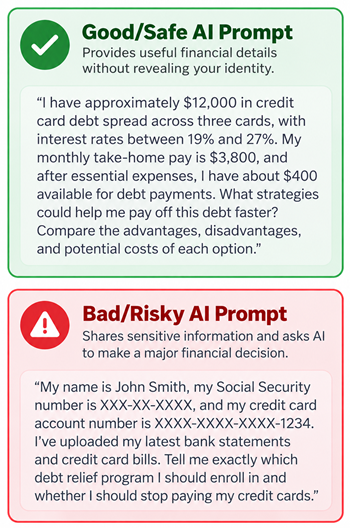
Understand how the AI service handles your data
Not every AI tool follows the same privacy practices.
Before using an AI chatbot for financial questions, review its privacy settings and policies. Find out:
- If the company retains your conversations, and for how long
- If your conversations will be used to train AI models
- If you can delete your conversation history
- If the information is shared with third parties or connected applications
- If the tool requires access to your bank accounts or other financial services
Some specialized financial tools offer secure account connections, but you should still review the permissions and understand what information the service can access before connecting accounts.
How can you know if the AI is providing good financial advice?
AI can sound extremely confident and authoritative even when it’s wrong, which is a bad combination when you’re looking for financial advice.
AI agents sometimes generate inaccurate information, misunderstand questions, make calculation errors, or cite sources that don't actually support their claims.
Financial information also changes. Interest rates, tax laws, student loan repayment programs, bankruptcy rules, and government assistance programs may be different today than they were when an AI system's training data was collected.
So don’t just assume that the advice you get back from the AI is always going to be pristine.
Here are some ways to evaluate the advice before you put it into action.
Verify important information using trusted sources
AI should be a starting point for financial research, not your only source of information. When evaluating financial advice, compare the response with information from reputable organizations.
Some useful resources include:
- Consumer Financial Protection Bureau (CFPB) | Information about credit cards, debt collection, mortgages, credit reporting, and consumer financial rights. | consumerfinance.gov
- Federal Trade Commission (FTC) | Current news about financial scams, identity theft, debt relief advertising, and consumer protection. | consumer.ftc.gov
- Internal Revenue Service (IRS) | Official information about taxes, tax credits, and the potential tax consequences of forgiven debt. | irs.gov
- Federal Student Aid | Information about federal student loans, repayment plans, forgiveness programs, and default. | studentaid.gov
If it hasn’t already cited sources, you can also ask AI to provide links to original sources. However, don't assume a source is reliable simply because AI provides a citation. Open the link and confirm that it actually supports the information presented.
Make sure the advice is current
Financial rules and regulations can change quickly.
For example, an AI response about student loan repayment might describe a program that has been modified, discontinued, or affected by a court decision.
Before following advice involving government programs, tax requirements, or consumer protection laws, ask: "Is this information current? What official sources can I use to verify the latest rules?"
Even when AI claims to have checked recent information, verify important details yourself.
Double-check financial calculations
AI can make mistakes when calculating interest, estimating loan payments, or comparing repayment scenarios.
If you use AI to determine how long it will take to pay off a credit card (and you need that calculation to be accurate), verify the result using a reputable payoff calculator.
Pay particular attention to the assumptions used by the AI, including whether interest is compounded daily or monthly, whether the interest rate is fixed or variable, and whether additional fees have been applied.
A small calculation error could lead you to underestimate the cost of a loan or overestimate how much you can afford to borrow.
Be suspicious of guarantees
Be cautious if an AI tool suggests that a particular financial strategy is guaranteed to work or has no meaningful risks. That’s generally not true when a human says it and it’s just as suspicious when an AI says it. Financial decisions almost always involve tradeoffs.
Similarly, AI shouldn't promise that you can eliminate debt without consequences, qualify for a particular loan, or achieve guaranteed investment returns.
Good financial guidance should explain both the potential benefits and the risks.
Know when to consult a financial professional
AI can help you prepare for a conversation with a financial professional, but it isn't a substitute for real, personalized professional advice.
Even AI itself seems to recognize this. Here at MMI, we’ve seen a nearly 50% increase year-over-year in the number of clients coming to us for help through a recommendation or information they received from AI.
Consider skipping straight to professional assistance when you're:
- Facing a potential foreclosure, repossession, wage garnishment, or debt collection lawsuit.
- Deciding whether to pursue debt settlement or bankruptcy.
- Making major investment or retirement planning decisions.
- Dealing with complicated tax questions.
- Thinking about using a financial product that could put your home or other important assets at risk.
Depending on the situation, you may want to speak with a nonprofit credit counselor, certified financial planner, tax professional, or attorney.
Ultimately, AI can be a great first line of support if you have questions about your finances and are beginning the process of creating and implementing a plan. AI should not be a financial decision-maker. It’s up to you to validate the recommendations provided by AI and decide if those recommendations truly make sense for your situation.
If you could use some financial advice from certified (human) experts, MMI offers free financial counseling 24/7, online and over the phone. We can help you review your financial outlook and come up with a plan for your credit card debt that gets you out of debt up to 7x faster than just paying on your own.