Show Notes
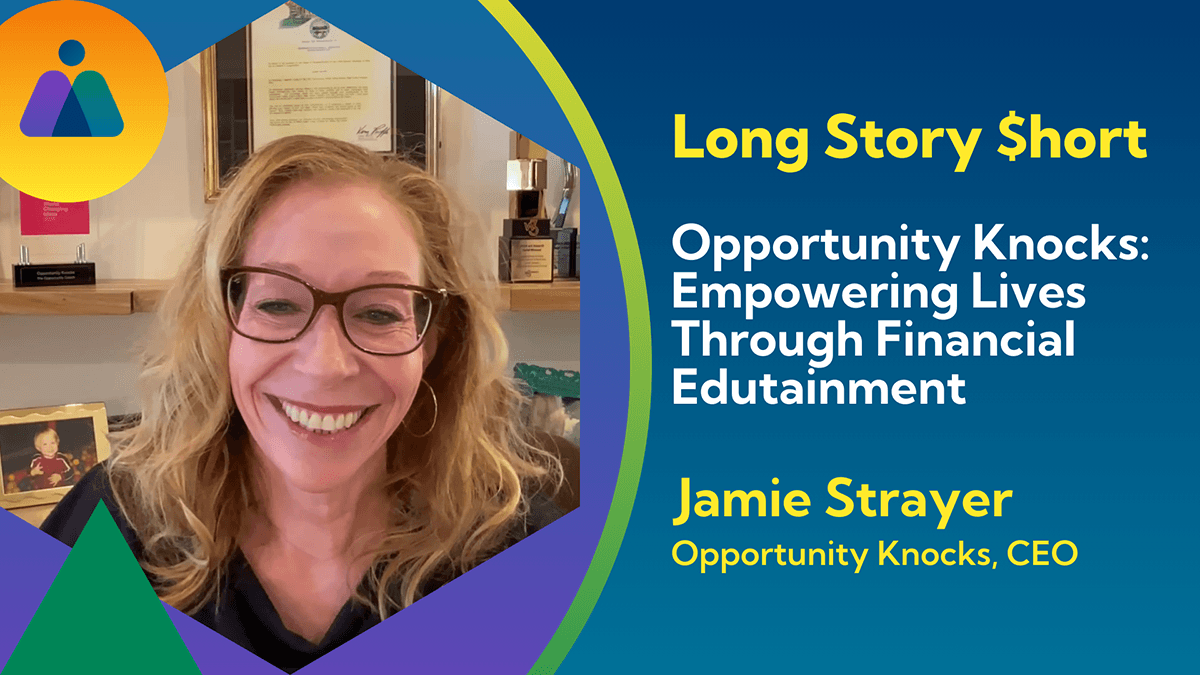
- Guest: Jamie Strayer
- Host: Tara Alderete
- Publication Date: March 17, 2026
Highlights
- Jamie explains how her mother’s legacy inspired her to create Opportunity Knocks.
- Jamie talks about the positive outcomes that the families profiled on the show experience after working with a financial coach.
- Jamie and Tara talk about the importance of teaching financial literacy from an early age.
- Jamie talks about the many tools and programs offered through Opportunity Knocks.
Episode Transcript
Note: Transcripts are machine-generated and may contain errors.
Tara: Hello, I am Tara Alderete. Welcome to Long Story Short. We have a great episode for you today. Jamie Strayer. CEO and creator of the series Opportunity Knocks on PBS is joining me today and I cannot wait to dive in Here at Money Management International, we believe that financial challenges aren't meant to be faced alone. And financial wellness is a journey. On this podcast, we hear stories of people whose lives have been changed by MMI. And we also hear from the dedicated partners helping to make a difference. These stories are unique, personal, and inspiring. Stay tuned. We're sharing each guest's long story short. Jamie, we are thrilled to have you here. Welcome to the show. Thank you so much. I'm grateful to be here. Thank you. Why don't you just start off by telling us a little bit about you?
Jamie: I appreciate that opportunity. I was a single mom for 17 years. And grew up in Ohio. My mom managed the employment office in our town and in a small town that's more than pushing papers. She worked with nonprofits and helped people to overcome really challenging situations in their lives. And it it was truly an inspiration to me.
Tara: Oh, that's awesome. I love that. So Opportunity Knocks has had some really great success. It is now in its third season and was just named Best Feel good show of the year at the American Reality TV Awards in November. Congratulations to you for that. For listeners who may not know or be familiar, what is Opportunity Knocks?
Jamie: Opportunity Knocks is an inspiring television series that features the everyday challenges and struggles of American people that are underestimated. And let's face it, we've all been underestimated at some point in our lives. So it's something that anyone watching can see themselves in and feel like, you know what, I'm not alone. And as most people in the country are struggling to make ends meet right now and feel like they're on a treadmill that they just can't get off It's taking the reality that people are not alone. And there are all kinds of resources in their own communities to help them to get off that treadmill and to feel less stress. into their homes, on their couches, on the TV where they're comfortable to reduce shame and increase access to move forward in life
Tara: I love it so much and I watched some of the clips and some of the episodes in preparation for this conversation and I can't tell you how much I love this show. So where did the idea for the show come from? And how does it really reflect the financial condition of the average American family today?
Jamie: The idea, I think, that anything that we create in life comes from a lot of different areas of inspiration. And my mom had passed away. And there was really a silence that I was sitting in and saying, what is my legacy? You know, she did so much to help people that were struggling. And it it occurred to me that even as a single mom, she showed me how to access programs that really put food on the table for my son and I. and to pay the electrical bills, to get a resume done, education programs that I could learn a skill and Not everyone knows the where those programs are and it's hard as heck when you don't have time. You're working one job, you're tired, you come home to your kids, you're working two jobs maybe. And so applying that to an insight that I'd read about 16 and pregnant, reducing teen pregnancy. The idea of reality television, there's a shaky camera. We feel like we're in that room. And so when we look at and can see other people experiencing the same thing we're experiencing, and that it is possible to move beyond these deep challenges, then it restores a little confidence and hope that maybe that next foot can be put forward and the the next one and the next one and also here's some places you can go for help.
Tara: What a legacy your mom left and what a way to honor her. I love it. So, what can folks on the show expect from the process and the financial coaches? They work with financial coaches. And what are some of the outcomes that you've seen of these families?
Jamie: I'll start with the outcomes because it's just that's that's where it's at. Like everyone wants to live the best life and they want their kids to live the best life. So the families featured in the series And it it's mirrored. We actually have a live tour going around the country called Opportunity Knocks Live, where we're doing the same thing in cities all across the country. The families featured in the series. Once the toxic financial stress is eliminated and they can start to breathe, they increase their incomes by an average of $19,486. Like nearly $20,000. that people are making more. We can't begin to think about ways to make more money or plans for the future if we're so stressed out. about where we're at right now. How am I gonna pay that bill? What about that credit card bill? My car payment's too high. It's just too much to even begin to think about what's next or where to take those steps. The first thing the coach works with the family and the series on is identifying where that stress is at. So as they go through identifying what is really siphoning or stealing money from the house and you know that and your coaches at MMI see this all the time. It's high interest debt. And there's a bit of that that compounds on the shame. It's impossible to search for rates unless you have A plus credit. Oh, it's 4. 99 or 7%. Yeah, but I don't have perfect credit. I'm struggling to pay my bills. And so I don't even know where the best rate is. So how could you begin to contemplate saving money. And that is far more savings per month than not drinking a cup of coffee at Dunkin' Donuts or Starbucks. When the coach identifies where that drain is and helps people to keep more of their money, it's either with working with an organization like MMI that looks at debt restructuring or at a not-for-profit credit union that does refinancing. There are a lot of great banks and we are building an ecosystem of supporters. that are behind and part of what we're doing, but not for profit credit unions are typically in a community the primary providers of debt consolidation loans. That's a personal loan. And it takes all your credit cards and it'll put it down into one lower payment. And so in our series That looks like families taking what and saving about $1,000 a month or $400 a month, which is astronomical just to have like, okay, here's $400 a month back in your life And the payoff goes faster. By the end of the series, families have 50% less debt. And you and I know that creates available credit, which increases the credit score, which allows them to refinance an auto and save another $200, $300 a month. And by the end of that, You know, not only are they making more money because oh my gosh, I can pay all my bills on time, but they're also saving more money.
Tara: It's momentum. People start to feel like I can save money. I can pay off debt. I can make more. I can do things that I never thought that I'd be able to do before. What an incredible thing. Gosh, I love it. And I love all those things compounded in such a fairly short amount of time and that people can really sort of see the winds. So we talked a little bit about the crushing feeling that can come from high interest rates and debt. What would you say is the biggest financial challenge that most people are facing today?
Jamie: The biggest financial challenge most people are facing today is making ends meet. It's been a challenge. It was a challenge before inflation. Inflation is also an intimidating word. Like what does that really mean? It sounds like some PhD some study that I don't know what it is. It simply means you're paying more at the gas pump and more for groceries and the interest rates are going higher, so you can't even refinance your mortgage because, you know, if you do, you're paying more for your mortgage each month. If your car breaks down, you're gonna pay more for your car because the interest rate's gone up. You're paying more for everything. Yep. And people already have credit card debt. So if if they already weren't making ends meet, then they're going deeper into debt using that credit card more to make ends meet. uh touching back on the conversation we were just having, that part of that relief, it's not only what they can see in our series, but it's it's a big reason that People feel so relieved when they're working with MMI because it is those steps forward. It is seeing and hearing from their friends that step forward. But a lot of people are struggling in silence. They don't feel like they can even ask anyone for help. And that's just not the truth.
Tara: I agree with you. And so we'll talk about that more in a minute. I wanted to touch on something a little bit we talked about, you know, making ends meet. I read recently that the average American lost almost $1,000, $948 last year, simply due to lack of financial knowledge. And we also know that financial knowledge is decreasing with each generation. Yet we spend over six million dollars annually on financial literacy initiatives in on our country and 26 states now require that in high school. Why do you think there's such a big knowledge gap still when it comes to money? That's a very complicated question.
Jamie: And some of it I think that people inherently know and experience, which is Financial literacy, even though we're investing a lot in wellness, is underutilized. And let's face it, even the word literacy that might be appropriate for kids. But if there's a financial literacy class or training or workshop, you're asking people to raise their hand to walk through the door and say, I am illiterate. And I I do not believe that people are illiterate. I believe they're underestimated and our system lacks transparency. And it's one of the reasons there is so much distrust. So if people are literate and understand that there's lower interest rates to pay, then they would be calling up. to financial institutions saying, you know, my credit score is a 620, what's my interest rate? And it will not be provided But it just doesn't happen. And the online platforms that are like you may qualify for this, they're not giving people the best rates. They're giving people the recommendation that pays them the most. in a fee to show it to them. And so if we look at these real life situations and people are like this the a lot of people believe the system's rigged against me. And it may not be rigged against them, but these experiences of barriers to even like understanding what a credit score is, understanding how to use it, how do they use it when there isn't access to that and then we're compounding that shame by saying you're illiterate. And I think that there's a real disconnect in that and that transfers over into schools because when we're teaching financial literacy in schools and really if we're looking at where the term literacy would be appropriate, like we're teaching kids to read in school literacy. that and it it's not increasing that shame. There are kids whose parents don't have spare money to give them for allowance. Right. Right. There are kids that see their parents struggling with these things. And the shame comes in there that it's very esoteric. It's it's not something that they can bring down into their own lives. I actually own another TV series called BizKids, and it was on PBS for things going on 20 some years that it's been on PBS and it has seven seasons. And it showed kids how to manage money through their own businesses. And let's face it, I don't know about you. But I played store with my stuffed animals when I was a kid, right? And the lemonade stand. And so it makes it accessible in a way that doesn't have oh my fa my family doesn't have that money to pay me and my parents you know an allowance my parents already struggled that isn't shame an off putting I I believe that shame is the biggest barrier to people participating in and learning from the education that's out there.
Tara: I agree. Let's talk more about that shame and stigma. You know, there seems to be such stigma around money and debt. And as we've been talking about, it affects all of us in so many different ways. Things like Opportunity Knocks it is incredible in working to address that. But what else do you think can be done to help people realize they're not alone and help is available?
Jamie: Well, so we created the Opportunity Hub. And it takes scenes from Opportunity Knocks where organizations like MMI and the United Way and the the not-for-profit credit unions and other financial institutions working with people where they're at and talking to them in a in a way that they can see and feel that they're not alone. And it trains other organizations to do the same thing. And if we look at at financial institutions, the frontline workers, well they're making in in just above minimum wage too on the teller line. There are a lot of them that have payday loans. And it's it's just not widely known. The people in the financial institutions, you may think when you're walking through that door that they aren't like you. The reality is they are. And so we have this training available and it's it's it even has role playing for financial institutions and not nonprofits. to show what it looks like to be in the person's shoes they're in and how to reduce that fear in a way that's the best practice of the best practice that we're featuring in the series.
Tara: I love it. Let's talk more about tools. So one of the things that I love so much, and I love a lot about Opportunity Knocks, but one of the things I love so much. is that it's more than a reality TV show. You don't have to be on the show to be part of the success. There are tools and resources that anybody can use. So what are those tools and how can people access them and how do they work?
Jamie: Well, they can learn how to use them by watching the show because miracles aren't happening falling out of the sky for the people in the series. when the coach meets with them. And we love, we have Gene Chatsky from The Today Show and the Oprah Show, who's one of our coaches, and Luis Brajas. Who is a a financial manager for some of Pop Latino's greatest stars? Not Bad Bunny, but some other ones And uh Patrice Washington, who was on the Steve Harvey show as a financial expert, saying, listen, this is your situation, listening with empathy and saying, you know, here's what I recommend for you personally on these past. But then saying, I want you to go to the Opportunity Finder. And the Opportunity Finder has 17,000 nonprofits in communities all across the country. And the viewer or user listening to to your podcast here, when they go to it, they can type in their zip code or even their address and it'll give them choices. How I need to I need to keep more of my own money I need to pay less for my car. I need to pay less for my credit cards. I need to make more money. I want to start a business. I need help with my resume. I need to pay my taxes. I'm behind on my rents. I need to fight eviction. And one of the things that we didn't expect, there's a category I need to get out of that relationship. And hundreds of women have been using it and it leads to domestic violence shelters. We didn't realize the show that we're making about finances. And let's face it, it's never just the finances. It's the child care. It's the efforts. Every point will lead to outcomes Like that. People can find anything that they need that's holding them back in life.
Tara: You know, it's interesting. We have had a couple of conversations this season where that topic has come up. financial abuse and psychology of money and why we behave in the ways that we do. And I agree, you know, these things are so tightly knit together and sometimes we don't realize them. So I love that people can not only access this tool to change on the surface their financial situation, but really, really get to all the different root causes of what is a barrier. It's amazing. So Beyond these tools that we just talked about, what is some practical advice that you would give somebody listening that wanted to change their financial situation today? What's something they could do today? Where could they start?
Jamie: We do have another tool that guides step by step, and it's called the Opportunity Coach. And this is what I would tell people to start right now, besides calling MMI, but they probably already called you if they're listening to your podcast. Our tool, the Opportunity Coach, it is a personalized plan. Everyone deserves a coach, not someone that's teaching them financial literacy, but someone that's really on their team that they can feel the support from. And whereas There's not enough coaches for every single person. There is a tool that can guide them and you answer a few questions. Like you know, how are you getting by? Do you have enough at the end of the month to pay all your bills? And and you answer, you know, not enough, some, or I'm actually fine and saving. But then it it does that all the way around. What's your level of stress And so when the the plan is done, it loads all of these next steps. And that next step can be, you know, learn more. Do you know your credit score? No, I don't. Okay, well here's the basics of it. And it's fun. They people get points and they can get prizes for doing it. And, you know, as far as reducing shame and wanting to do something, it's certainly motivating. Sure. And then as they move forward, they can take that next step in learning in the comfort of their own home, but with a plan that's just for them, not a drop-down menu on some website and maybe I'll go through things and pick up a little bit here. It focuses on what they need to move forward.
Tara: Great. So if you're listening and you're wondering what can I do today, you can check out that Opportunity Coach and get a customized plan and start. I love it. Jamie, you've had such tremendous success with the show and you've got such passion. I can hear it in your voice. What's next on the horizon? What can viewers and followers expect?
Jamie: Wow. Um, so we are in the development of an AI tool. Well, we're I I shared with you one of the things that As we're going through this, and it it's an entire ecosystem, right? We have just watching the TV show isn't enough. We're doing Opportunity Knocks Live. We're bringing it to communities for people to like go through it as if they were on the show themselves working with all kinds of nonprofits from the United Way to free pro bono attorneys to resume help. So excited by that. If you're interested in that, drop us a note on OpportunityKnocks.net and say "bring this to my community." We absolutely will. We're laying out our tour. So that that's something on our horizon as we add more. We did our first one in Tacoma, Washington The governor of Washington State proclaimed Opportunity Day. So did the mayor. We had children dance troops opening the day up. It was a giant celebration and we saved people half of a million dollars. Oh my gosh. In a matter of hours. I'm not kidding. I'm not. It is so incredible. And we did after surveys and 93% of people had a major life challenge solved that day besides just the half a million dollars that was saved. And 100% of people felt treated with dignity and respect. Like if we look at I have goosebumps even sharing that with you with such joy that that's that's exactly where we want everything that we're doing in true financial wellness to lead to.
Tara: Yes. One hundred percent of people feeling like they are treated with dignity and respect is the goal. And I think especially when we're talking about a topic where people feel such stigma, such shame, such embarrassments. Such so it's only me. That right there is huge and amazing. I'm excited. I am chills. I'm excited for you. I have one more for you and I think that it will bring you chills too.
Jamie: So we we've tested it. We tested it at that event. That's how we save people half a million dollars in just a few hours. And It is being soft launched. So we created an AI tool, an add-on to one that's being used in employers and nonprofits, so that but it'll be on our website too. And that issue where I was sharing that people could not even know what rate they deserve or like how do I have I have this credit card debt. I don't even know if they'll say yes and it's gonna be intimidating to go Right. People share by text. So not on some computer. What's this AI business? You can text back and forth with it and it'll say, do you you know, are you having financial stress? Yes. Do you have credit card debt? Are you paying too much for your car loan? Do you have a payday loan? And they can say yes to one or multiples of that. And it backs into and only provides them. the best interest rate they qualify for and where they qualify. It's always and only in the user's best interest. Always and only. There's no fees from an institution saying we're going to give you the money to put ours before anything else. It's always and only what's going to save the users the most money and and get them the lowest interest rate.
Tara: That's so empowering because I imagine people feel set up for success when they walk in the door. They know they're gonna have success.
Jamie: I think that that was one of the big reasons that the surveys came out of Opportunity Knocks Live in Tacoma the way that they did. And I'm just so excited about making that available on our website that people can just text with it. And it it's so easy. It says like, when did you get your car loan? How much did you pay for your car and then you click to get a free credit score and says, you know, well you can learn about that later. But the most important thing is put in that number right now. And then it says it looks like And that compares to national averages. It looks like we c you could save four hundred dollars a month Do you want to be connected to the n financial institution that would give likely give you this rate? And then it connects them to that institution and it says and you don't have to stop there. If anything goes wrong there, here's another one. And it's the next one in the line that they would qualify for and say the most money.
Tara: Oh, how incredible. Okay, so we've been talking about some really, really good stuff. Opportunity Knocks Live, the Opportunity Finder, the Opportunity Coach, this AI tool. There's a lot. So OpportunityKnocks.net, how can people learn more and connect? For listeners who might be thinking, I I want to go see Opportunity Knocks Live. I want to be on the next season of the show. How can they do that? How can they apply? How can they find all these great resources?
Jamie: They can apply to be on season four on our website. And all of the resources are also available on OpportunityKnocks.net. So we want everyone to have access and to build their better lives with us. We are building an opportunity ecosystem and bringing it right into people's homes.
Tara: This has been the best conversation. I was excited coming in and I'm like, oh, I can't even tell you how much excitement I have walking out. Before we wrap up, is there any final piece of advice or inspiration? You're such an inspirational person that you'd like to share with anybody listening?
Jamie: And believe in yourself. You deserve the best You know, if if there's anything that you're feeling bad about that you think you deserve with with the debt you have, you you don't. We're all trying our best. Nobody's trying their worst in life. So if you feel like you can't talk to someone or you're not doing it right, and we hear that a lot, all the mistakes I've made. I don't know that you've made mistakes. Because you are just trying your best. Yeah. And uh the next thing I'd say, which is is something my husband says, and I just love it the best time to plant a tree was twenty years ago. You know when the next best time is right now. Yep. So if you're having that stress come to OpportunityKnocks.net right now and start working on it because you too can build a better life, reduce your debt, increase your earnings, and have less stress.
Tara: Believe in yourself. Jamie Strayer, OpportunityKnocks.net. Please go check it out Use the tools and resources. Look for Opportunity Knocks coming to your town and please get involved. Thank you, Jamie, so much for joining us today. Congratulations and best of luck in all of your future endeavors. I'm excited to follow. Thank you so much for the opportunity. Thanks for listening to this episode of Long Story Short, brought to you by Money Management International. To learn more about our work and how we're helping people in all walks of life repay debt, balance their budget, and find lasting financial peace of mind, visit moneymanagement.org.
Return to main podcast page