Show Notes
- Guest: Mel Lanning
- Host: Tara Alderete
- Publication Date: April 14, 2026
Highlights
- Mel explains the history and mission of the BBB Institute.
- Mel talks about the huge increase in financial grooming and relationship scams and how to spot these types of scams.
- Mel shares some scam red flags and provides tips on how to keep yourself safe.
- Mel and Tara talk about the BBB Scam Tracker, where to find it, and how it can help you determine if something is a scam.
- Mel shares that Scam Survivor Day is on May 14 and explains why reducing the shame and stigma around being scammed is so important.
Episode Transcript
Note: Transcripts are machine-generated and may contain errors.
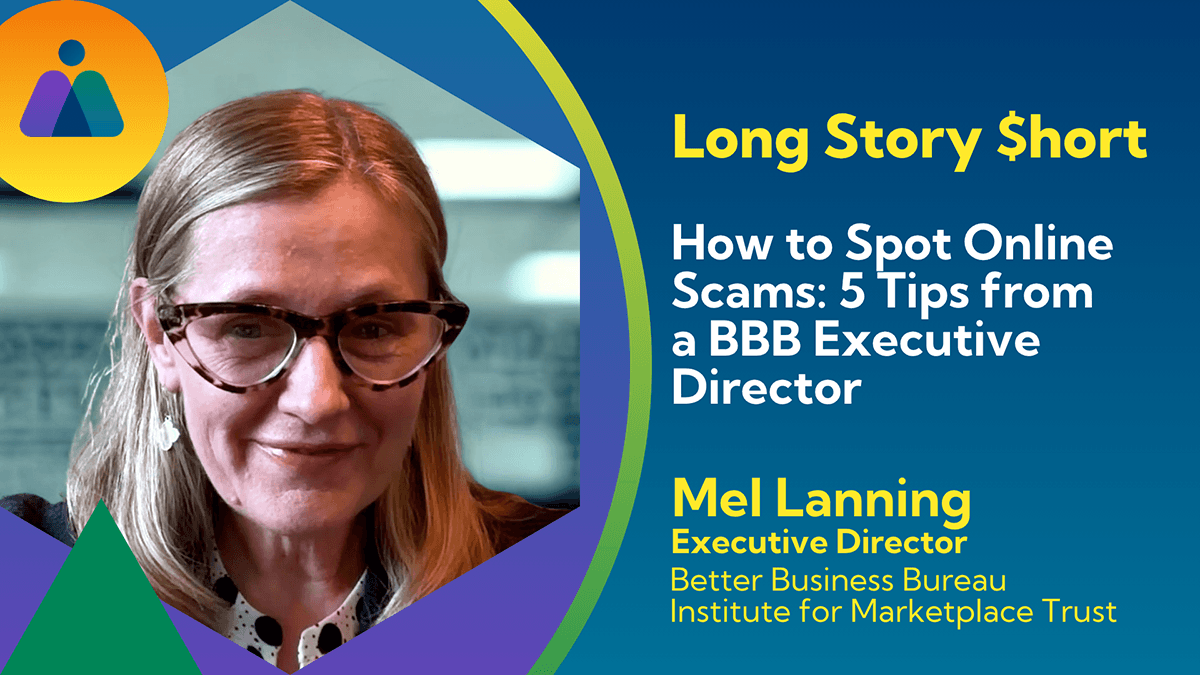
Tara: The Pew Research Center reports 73% of U. S. adults have experienced some kind of online scammer attack, and most get scam calls, texts, and emails at least weekly. That is a number that's hard to ignore. Mel Lanning, Executive Director at the Better Business Bureau Institute for Marketplace Trust, is with us today to share tips and tools to help us spot and avoid scams. This is going to be a great episode. Here at Money Management International, we believe that financial challenges aren't meant to be faced alone. And financial wellness is a journey. On this podcast, we hear stories of people whose lives have been changed by MMI. And we also hear from the dedicated partners helping to make a difference. These stories are unique, personal, and inspiring. Stay tuned. We're sharing each guest's long story short. Mel, welcome to the show. Thank you for having me here today, Tara. Thank you so much for being here. There is so much to cover and I can't wait to dive in. But first, tell us a little bit about yourself.
Mel: I joined the BBB Institute for Marketplace Trust about eight and a half years ago, although I've been in the nonprofit world my whole career. When I joined BB, the scams and fraud prevention was very new to me. So it's been eight and a half years though, and I have learned a lot, and I am happy to be here and share what I've learned today.
Tara: I'm happy that you're here too. Eight and a half years is a lot of experience and I know scams and fraud are on the rise So many of us know the Better Business Bureau as the place to go and check for reputable businesses. But for folks that are not aware, could you talk a little bit more about the Institute for Marketplace Trust and its mission?
Mel: I'd be happy to. So BBB Institute is the 501c3 Educational Foundation of the Better Business Bureau. Our mission is to advance marketplace trust through education, innovation, and collaboration with our network. of better business bureaus serving communities across the United States and Canada, as well as all other fraud fighting partners. Our vision is a trustworthy marketplace for everyone. Unfortunately, bad actors perpetrating scams in the marketplace erode trust, which is why so much of our work involves fraud prevention activities. We know that knowledge is protective, so we work to ensure that the public has access to the information they need to protect themselves as well as others.
Tara: It's such a good thing happening and I I'm just excited to talk more about the tools and resources. 73% of adults experiencing a scammer fraud though. It seems like nobody is immune. But different groups might be targeted in different ways. And so how do you guys at the institute address those sort of specialized scams?
Mel: So it's very, very true, and it's really important for all of us to understand that all of us are going to be targeted by scams and all of us are somewhat susceptible to it. And so it's important to know that nobody's immune to this. And so however, to your point, Tara, we can get a better understanding of typical scams that are more likely to target our age group for example. That information is helpful for all of us. So a good example of that is that In our research over the last few years, we found that the number one riskiest scam for young adults are employment scams, are those job scams, and I could talk a little bit more about those later, but That makes sense, right? Because that age group we know they're looking for work. And so they're potentially more susceptible than other age groups, although other age groups are also impacted by that scam type. When we look at older ages, we find that investment crypto scams, those are cryptocurrency scams involving in you know some sort of investment opportunity. those tend to be riskier for everyone as well, but also particularly for older adults. So another example of this would be the fact that military spouses, so we do track by whether people are part of the military or not, or if their family's part of the military and how susceptible they are. And so over the last several years we've seen that employment scams are risky for military spouses who are moving around and trying to find those remote job opportunities. Sure. And then we've also seen that they're also more susceptible to home improvement scams. So again, they're they're moving around and having to, you know, get n homes and get homes ready to to move or ready to move into. And so All those things do play into our exposure to certain scam types and that's important. It it it but again I go back to pointing out what you first said and that is everybody is going to be targeted by scams and There are just general things that we can do to protect ourselves overall.
Tara: Yeah, and that feels so dangerous because there's no one size fits all. It's like wherever you are in your life, whatever you're sort of doing or looking to do. the scammers uh most know it and they're coming after you. If you had to say what are the top three scams that are affecting consumers across the board, what would those be?
Mel: One that I would say is having a huge impact, and that's been over the last three years, we've seen a huge increase, those would be financial grooming and relationship scams. Okay. And so those are those types of scams where they start out as a friendship or it might be romantic, so we've heard of romance scams, right? BBB has expanded it from romance scams to sort of romance slash friendship slash relationship scams because it doesn't have to be romantic. for the scam to happen. But what happens is people meet them, it could be a random text, you know, where it's a text where somebody got the wrong number and you're being nice and you're telling them, sorry you got the wrong number. But that's scammer knows and they start a chance to start a conversation with you. It might be a direct message on social media, you know, where they they reach out and start a conversation and I would just say that scammers are real experts at this, right? They have a psychological playbook. They know how to keep the conversation going. They know how to find commonalities, things that they want to keep the conversation going with you. This could go on for weeks, it could go on for many, many months, but the the objective for them is to build trust before they start to perpetrate their scam. And so what happens eventually once they feel like they're in a good place, they built enough trust with their target. then they will come up with either an emergency that they need immediate help, they need money for. And what's happened over the last few years that we've seen an increase is suddenly there's an investment opportunity. They happen to be wealthy and this is how they made their money And they can show you how to make money too. One of the common ways is cryptocurrency platforms, for example. We've seen a an increase in those fake crypto platforms where you put your money in, you start to see Your funds grow quickly. It's very exciting for people. They're willing to put more of their money in until they've put in a lot of money. seen people lose their life savings doing this oh my god until they realize that they now don't have access to that platform anymore and that it's actually a fake platform. So that's a big one that is having devastated consequences for people. Wow.
Tara: And it it's kind of merged together. So it's these relationship scams that sort of lead to these cryptocurrency scams. And it sort of melds together. Wow. So how can we spot that kind of stuff? And what can we do to safeguard against these types of scams?
Mel: So what I would say is knowledge is protective. We know that the more you know about how scams work and and particularly the red flags, that the more able you will be to be able to spot that scam and avoid it. hang up the phone or move out of that browser without doing anything or just don't answer that text. So just a few general red flags for people to keep in mind. Yeah. If it sounds too good to be true, it probably is. Anything that's a really good deal or here's an investment opportunity, there's no risk, we know that there's no such thing, right? So It anything that just sounds way too good to be true, you need to s step back, take a pause, and and analyze the situation. If somebody's pressuring you to act too quickly, That's a huge red flag. Nothing is so urgent that you have to make a decision in the moment at this time, right now. That's a really big red flag to sort of again take that pause, step back, and and analyze the situation They may tell you not to talk to others. That's a big red flag. So for example, if you're on a job platform or a dating platform and that person says, let's go talk over here. And let's go over on WhatsApp or Telegram or one of these other platforms. That's another big red flag, right? Because what they're doing is they're removing for you from a place where there might be somebody that's able to intervene and detect that conversation, they're moving you to a place now where they can they can have it to themselves where there's not a lot of monitoring. So that's a big red flag. If they tell you to pay in a specific way, also a big red flag, so here's a check, this is what you need to do with your check. If they're being very, very specific on this is how you you know go get a gift card. We're gonna talk to you while you go to the store and buy gift cards and give us the numbers. Those are big red flags. Any sort of unsolicited message that you get, whether it's on the phone or in your email or a text message, that's the time where you don't ever answer immediately, you go and you find, you know, if it's from your bank, you go call your bank directly. You go to your account directly. You never respond to that email or that text or whatever the message is. Make sure you go directly to the place that you know is legit and and figure out if there's a situation going that way. Never respond to it. If they ask you for personal information, that's another big red flag, always be careful about providing your driver's license or any of that information, because that can be used for identity theft. A few other quick things. It's always good to freeze your credit if you can. Mm-hmm. It's free. You can unfreeze it. It doesn't impact your credit health to have it frozen. That just makes sure again back to identity theft, it means people can't take out a credit card on your name, or can't take out a bank loan in your name. So Uh that's one piece of advice I would say, just always have it frozen unless you need it. It's really easy to unfreeze it when you need to for a short period of time. Make sure you update your software on your phone and your computer regularly. Those are those patches that are meant to protect you. Don't ignore those messages.
Tara: Okay.
Mel: And also just multi-factor authentication. I know it feels like a pain to some, but this is another factor that can help protect you and then last of all trust your gut if something just doesn't feel right listen to yourself because we've done research with the folks that report to Scam Tracker and The bulk of the people that were able to avoid losing money when they were targeted said that they followed their gut. They just something didn't feel right. They couldn't put their finger on exactly what it was, but something didn't feel right and they just paused and and basically walked away from the situation.
Tara: That's such good advice. I almost fell victim to a scam and I did that. I waited a minute and I went back and I double checked. And you know, I thought, well gosh, if this is real and this is accurate, this person isn't gonna care if I double check. Right. And sure enough as I did, that's when I learned. But I'm they are very, very good. So You gave some really terrific red flags and things to look out for. And one of the things you said was do your research. Make sure you know who you're talking to. So you guys have a tool. called the Scam Tracker, which I love. And this is a great place for folks to be able to go and do that research. Can you talk a little bit more about the scam tracker and how that specific tool works?
Mel: Yes, I'd be happy to. BBB Scam Tracker has two main purposes, and you can find it at bbb. org slash scam tracker. The first purpose is reporting. And so it's a place where you can report scams and your scam report, we do share it with the Federal Trade Commission. as well so it does get over to FTC's Consumer Sentinel. But we encourage everyone to make sure that whether you've lost money or not, please report scams. It's so important. That data is absolutely critical for all fraud funding organizations. And so just take time. And and and the second reason, and this is the other reason to report and why it's so important, right? Is we also consider this a prevention platform. So when you submit your report to BBB Scam Tracker, we verify it on the back end to make sure that it's a legitimate scam report, and then we remove all the personal information and then we publish it on the website So those narratives and and that information, whether it's a URL you reported or a phone number you reported, actually gets published on BB Scam Tracker, which means if you're not sure if you're being targeted You can go into BBB Scam Tracker and actually search by phone number and URL and you can even just read through narratives. And sometimes we find that we talk to people That just being able to see other people's scam reports is incredibly helpful for people because they they recognize really quickly Oh wow, this really is a scam, and it's not just happening to me, it's happening to other people. So it's a really great place to go and either do that search or report a scam or just read the other narratives, which are very educational.
Tara: It's so good. I spent some time on this website and on that tool and you know you can filter by state and URL and phone number. It is amazing. And that's just one of the tools that you guys provide. So what other tools are available to help consumers fight these scams and fraud?
Mel: So a couple things as part that are part of ScamTrecker, we introduced a prevention guide that is also on Scam Trecker. It's part of the tool. And the reason goes back to what I mentioned at the very beginning, which is we know that knowledge is protective. The more you know, the more protected you'll be. And so this is a section that has quizzes that you can take to find out if you could spot a scam. It has videos around some of the top scams we're seeing with with key tips. It has a bunch of prevention tips. And it It has a wide range of just wonderful resources to just test your knowledge and build your knowledge. You can even get a better understanding of the scams that are more likely to target you and focus your research around that. The other tool that we introduced a couple years ago is called our Scam Survival Toolkit, and this is for people who have been impacted by a scam. Unfortunately, we've recognized that We focus the majority of our our work around prevention. However, there are people that are gonna be impacted, that are gonna lose money and be impacted by scams. And so this tool is meant to help them. And what they're able to do is they can go to this website and answer just a few key questions about what happened during the scam incident and then based on their specific circumstance they will get personalized next steps on what they should do okay to to recover from that scam. And so It prevents you from having to go through content like pages and pages of content. So for example, if you paid with a gift card, you're only gonna read about what to do. about a gift card scam, not about all the other payment methods that we provide information on. So it's very it reduces your stress by honing in on your specific situation. It also has mental health resources because we know some of these Scams that are happening are really have taking a toll on people's emotional health as well. And there are uplifting stories from other scam survivors who have been through this who say basically you're not alone. This is not your fault. This is something you can get through and and I've been through it. So it's meant to really be a boost for people, but also give them very specific information they can use.
Tara: That's such a good resource because I think if anybody listening has ever found themselves in that situation, you know, you you have that moment where you realize, oh my gosh, it's that's you know, heart and stomach moment. I was the victim of a scam. And then in the next moment your head starts to go all these different places, like what do I do now? And so to be able to go someplace where it's like, okay, here's your checklist, this is where you start, these are the steps you take is amazing, uh specifically to that situation. So we've talked about some of the fantastic resources that you guys have and the the great work that you're doing and I love that you really do stay ahead of the curve. What outcomes or successes have you seen with these tools?
Mel: One of the premier things that we found with BAB Scam Tracker, and so that data I mentioned earlier is helpful as a it's helpful for any fraud fighting organization and it it That information helps us make decisions on everything that we do. It helps us target consumer education campaigns so we we're able to dig in and understand how to uh who to target with which messages and so forth. So it allows us to be very tallered with our outreach efforts. We share that with other fraud fighting partners as well. It allows us to publish research, which is available for free on our website, and that information is really allows you to hone in on like your specific demographic and maybe how you're being impacted. It also helps Because people can come in and search to find out if they're being targeted or not, if that scam was reported, if it's really a scam or not, we ask Estimate that BDB Scam Tracker helped people avoid losing an estimated $38 million in 2025 alone just by coming to the website and searching. And so We're really proud of that. As far as the scam survival toolkit, we don't collect any personal information from people when they're there for a purpose. We just want them to come in and be able to get the information and not feel like they have to share anything. But we have found that our for-profit, our nonprofit, and some of the government agencies that we partner with are really pushing that out. So we get great feedback from our partners as well as the foot people who've come there saying this has been really useful.
Tara: You know, I'm glad you said that because I wanted to ask if individuals or businesses or organizations want to get involved or work with you, partner with you, how can folks do that?
Mel: Go to our website, bbbmarketplacetrust.org, and reach out to us. You know, send us an email. There's a way right on our homepage for you to reach right out to us to become engaged with us. So all of our information we do we put that out to the public for free. We encourage if you're doing this work yourself, please feel free to to take those reports or any of those videos, any of the consumer education materials and share those with your family, your friends, if you're a nonprofit with your with the folks that you serve. We would encourage you to definitely Reach out and share that. That's what they're intended for. And they are free for everybody.
Tara: Okay. Great. The other question I have is. As you do stay ahead of the curve and we know, gosh, these guys are good. What's coming next? What's on the horizon at the Institute?
Mel: Yeah, the next big thing for us is Scam Survivor Day. Okay. And that is something that we launched in 2024 when we first launched the Scam Survival Toolkit. It takes place on May 14th. This will be our third year in a row. Throughout the year, we talk about their the scams and the impact they're having, and on this day we focus on scam victims specifically. We really focus on how to reduce the stigma. and how to improve what we're offering for victims. So it's a great time to remind everyone about the full impact of scams, that it isn't always just financial that this can impact a person's mental health and so much more. It can impact relationships with family and friends. It can be very devastating for folks. In fact, according to our research, about a third of the folks that we've surveyed over the years say that their mental health was impacted by a scam, and about 54% said they experienced anxiety stress. and or trauma. And then about 40% said they felt shame or embarrassment as a result. And part of the issue with that is if you're embarrassed or you feel some sort of shame about this and you shouldn't But if you do, you're less likely to get the help you need. You're less likely to talk to somebody and talk about what happened. This can happen to anyone. Scams have become incredibly complex. And scammers are are changing the game on us uh all the time. And so we want to remove the stigma and really like encourage anyone who's been impacted to reach out and get the help that they need.
Tara: So how can folks partake in Scam Survivor Day? Is it is it online? Where can we learn more? Go to our website.
Mel: It is online. We encourage anybody to to be part of this. We'll we have materials online so you can share information. on that day about the impact of scams, really spreading the awareness about the fact that sometimes we put the blame on victims when we talk about financial fraud. For for whatever reason, we sometimes speak in such a way that that person shouldn't have it should they should have avoided it and unfortunately it makes the situation worse and so we have All kinds of materials, including how to talk to scam survivors, the best way to do it to lift them up and get them the help they need. And so all that information is on our website. So I would just encourage anyone who's interested to go there. If you're interested in getting more involved to reach out to us and we can have that conversation.
Tara: Okay, repeat the website one more time. BBB Marketplacetrust. org. BBB Marketplacetrust. org. BBB Marketplacetrust. org. So scam survivor day, the scam tracker, tools and Sources Stay ahead of the scammers because you guys are helping us do that. Mel, this has been such a fantastic conversation and I know I'm walking away with more resources and I'm gonna go do more research. What sort of parting thoughts or advice do you have for folks?
Mel: I think that my parting thoughts would be: first of all, please remember that we're all susceptible to scams. Scams are getting incredibly complex. They're getting more difficult to spot when they're coming up. Even those of us like me who are doing this work every day. Even I have to stop myself at times and be like, oh my gosh, what's going on here? I have to really think about this. So and be kind to yourself. And to anybody else that you know who experiences a scam incident, the words you use can do more damage. It's important to remember that there is a stigma for scam victims and we need to get rid of it. And to remind ourselves that the a criminal stole this person's money. It's not their fault, right? It's the criminal's fault. And so that's another big thing that I just want to leave us with. And just a reminder that we have all this information on our website. Please come to bbbmarketplacetrust.org and whether it's Scam Tracker or Scam Survivor Day or our prevention guide to get more information.
Tara: Bbbmarketplacetrust.org. Mel Lanning, thank you so much for joining us. I really appreciate it. Thank you for having me, Tara. Appreciate it. Thanks for listening to this episode of Long Story Short, brought to you by Money Management International. To learn more about our work and how we're helping people in all walks of life repay debt, balance their budget, and find lasting financial peace of mind, visit moneymanagement.org.
Return to main podcast page