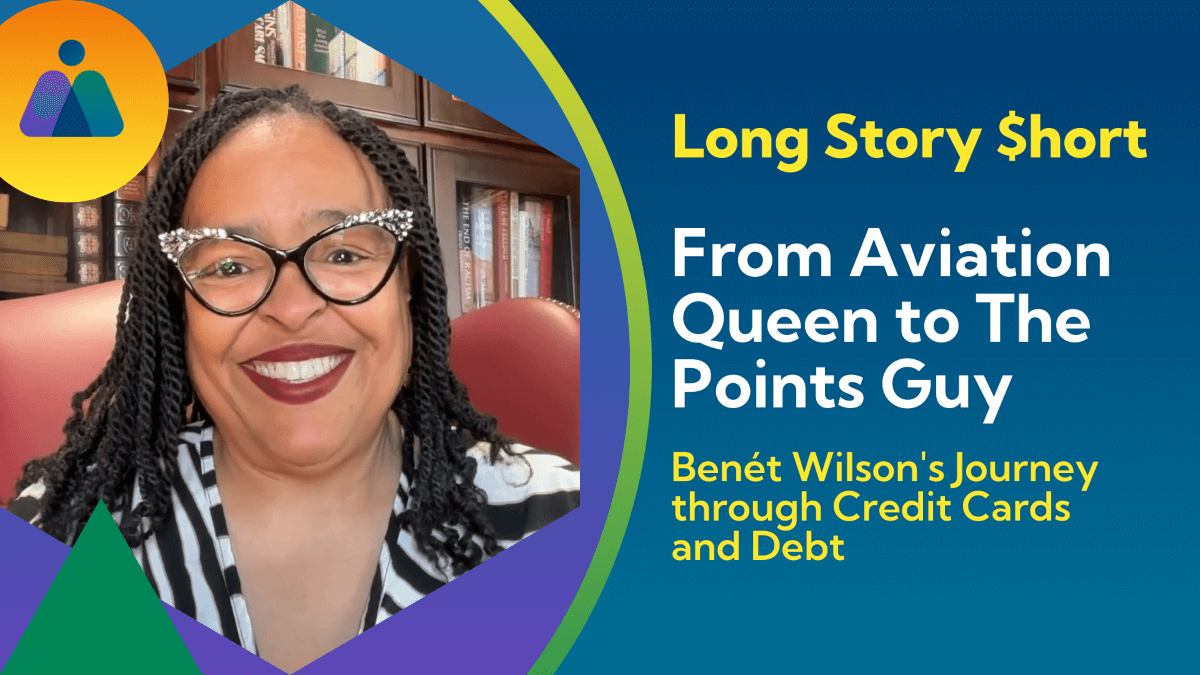
Show Notes
- Guest: Benét Wilson
- Host: Tara Alderete
- Publication Date: March 3, 2026
Highlights
- Benét talks about her experience as an aviation journalist and how her career shifted to travel credit cards, store credit cards, and eventually all things personal finance.
- Benét talks about her personal struggles with debt and credit and how those experiences shaped her perspective as a writer.
- Benét explains that it took her working with MMI multiple times for the necessary changes in her financial habits to finally sink in permanently.
- Benét shares advice on creating and maintaining a healthy relationship with credit cards.
Episode Transcript
Note: Transcripts are machine-generated and may contain errors.
Tara: Hello and welcome to Long Story Short. We have a fantastic episode for you today. I'm so excited. Benét Wilson is joining us. She's an experienced traveler, a journalist, a credit card and professional finance writer, training director, and former MMI client. As a professional credit card and personal finance writer with financial struggles of her own, Benét has a unique perspective on so many things money and credit, and I can't wait to jump in and learn more.
Debt. We've all heard of it. Most of us have it. Debt seems to be an unavoidable reality of life. But what happens when it starts consuming life?
Here at Money Management International, we believe that financial challenges aren't meant to be faced alone. On this podcast, we hear stories of people whose lives have been changed by MMI. Their stories are unique, personal, and inspiring. Stay tuned. We're sharing each guest's long story. Short.
Benét, welcome to the show.
Benét: Thank you so much for having me.
Tara: You've had such an interesting and amazing life. So give us a little background about who you are and what you do.
Benét: I am a longtime journalist, the daughter and granddaughter of military officers, Air Force, and I have lived all over the world. I was an aviation journalist for almost 30 years, which allowed me to also travel a lot. I got the travel bug very early on. And then after aviation, somehow I slid into personal finance and credit cards, and, you know, the rest is history.
Tara: That's awesome. You've worked for some really well-known names in the world of personal finance, like Bankrate and The Points Guy, just to name a couple. How did you get into personal finance writing, and is it something you always wanted to do?
Benét: It wasn't something I always wanted to do. 2016 to 2018, I was 100% freelance, but I was focused on aviation. And I was teaching a course to emerging manager journalists, and there was a woman in there who worked at the time worked at Lending Tree, and she saw my travel and aviation experience and asked me if I'd be interested in freelancing for her to write about airline, hotel, travel credit cards.
And I was like, I have no credit card experience. She's like, you don't need to. You know the industry. I'll give you an outline. And so the first card I wrote about was the Delta Airlines Platinum card. And she gave me a great outline, and I did a few of those, and then she hired me to edit and write a website that went away two months after I started.
It was called milecards.com. And two months after I got there, they sunsetted it. So I started writing about all kinds of credit cards. You name it, I probably have written about it. You know, store credit cards, all the travel credit cards. I mean, there's a credit card for everything. Okay. I learned that.
And while I was doing that work, one of my friends had become the editor of The Points Guy, and he reached out to me. He was from my aviation days. And so I got hired by The Points Guy. And then, you know, did that for a while, did a pivot, and then ended up at Bankrate.
Tara: Interesting. In preparation for this discussion, I was reading some of your articles, and they are great. I learned a lot. I think there's this assumption that journalists and writers, professionals like yourself, really just have it all together in their financial life. No struggles that are ongoing with credit or debt or money. But you sort of break that mold. So tell us more about that and how you're unique in that area.
Benét: I remember when I started at The Points Guy, I was kind of an anomaly because I had two credit cards when I walked in the door. Most of the other people there had at least 10. Some of them had 20. Some of them had 30. I mean, they had a lot of credit cards.
Tara: Sure.
Benét: So I had had my struggles. So one of those credit cards, it's my oldest credit card. It's a Capital One Platinum card. It's the one they give you when you're trying to rebuild your credit. And then I had, oh, I had a Macy's card, so, which I didn't really use all of that much.
But I had learned a lot about credit cards when I worked at Lending Tree and so ended up bringing that knowledge to The Points Guy. And on occasion, they would let me write about people who didn't have stellar credit. I mean, most of the people that write for The Points Guy, they have great scores and, you know, they have all the premium cards and all that stuff. So it was just interesting. I kind of brought a different perspective to the table.
Tara: Yeah. And I'm sure it was a perspective that a lot of consumers and readers really appreciate. Part of what we're doing on this podcast is really breaking stigma. So that idea that, you know, folks that do this for a living, they don't really have struggles or issues of their own is really not true. And I think when we realize that, it makes us feel a lot better about things.
Benét: Yes.
Tara: Benét, you shared in an article that I read that almost 40% of credit card holders have either maxed out a card or come close in the last few years. In fact, you were among them, and then you've gotten back on track again. And I think so many of us can relate to this feeling of being in sort of a cycle of rebounding debt. So how can we break that cycle?
Benét: Well, I mean, you have to be dedicated. You just got to, you know, I think what happens is, and it's happened to me, you see that large number and you're just like overwhelmed and you're intimidated and you're thinking, I cannot do this. I cannot do this.
That's why I came to MMI several times. It wasn't just once, people. It was several times before it kind of stuck. But knowing that there's help out there and that people aren't going to shame you and you just kind of dig in and do it.
MMI was so helpful because all I had to do was get the plan together, and then it just came out of my check. I didn't have to think about it. But my bills were being paid off, and I could see on my little dashboard, you know, when one was paid off, you know, it was like, yay.
And then I remember the last time I was with MMI, when that last one was paid off, I was like, never again. I have finally learned. And it does take a couple of times. Some people can do it one time. I think I was with MMI three times before it actually stuck. So perseverance. Don't beat yourself up. Acknowledge the money, the issue, and then find a way to fix it.
Tara: Ah. You said something important. Acknowledge the money and the issue, and then find a way to fix it. So it leads me to the next question I wanted to ask you.
You know, I think as we talk more openly about our experiences and struggles with money, we're also hearing more and exploring more this idea of the psychology of money. Why do people spend the way they do, especially when it comes to credit cards?
I read another article where you wrote about three psychological levers that keep people swiping that card. It was removing pain, overspending to gain rewards, and fear of missing out.
And the one that stuck out to me was overspending to gain rewards. If people set out to use rewards cards to their advantage, how can they avoid that sort of coming back to bite them?
Benét: It's kind of like the rat in the maze looking for the cheese. You want those rewards because you see the influencers and you see people writing about, well, I cashed in these rewards and I sat in this beautiful first-class seat, or I was able to book this fabulous, sweet hotel with a view of the beach, you know, that sort of thing. So it's really compelling. People want to feel like they can have things. So they'll spend the money and rack up all of these points, but then all of a sudden, you know, their card is maxed out.
So being more realistic, budgeting, just like you budget for everything else. You know, the people that I work with at The Points Guy, they knew how to play the game. They racked up their points, but they always paid off their bill at the end of the month. We had this article called The Ten Commandments, and one of them was, thou shalt not carry a balance into the next month.
So if you do it that way, you know, spend wisely. Use it to spend on stuff that you're going to spend on anyway, like groceries. That's a great way to get points and miles. But at the end of the month, pay it off. Do not, because once you start getting the interest, you are actually not getting that seat for, quote-unquote, free. You are paying for it.
Tara: You're right. And you're paying for it for a long, long time. Managing money, credit, debt, it really is a journey. And it was funny reading about your introduction into credit cards in college was so refreshing because it was very much like my own. The pizza, the t-shirts, and this love-hate relationship, as you call it, with credit, I could relate to as well. But what I love is that you talked about how you use your credit cards today after you've learned these lessons. And I love the idea that credit really can be used as a tool to help and not hurt.
So what's the wisest way a consumer can use their credit cards to their advantage?
Benét: I don't think that people need wallets full of credit cards. If that's what you do, that's fine. As long as you're paying it off, you know, that's your business. But I've become a lot more strategic.
So one of my, because my father was in the military, I have USAA, and they have really great credit cards. And I have one of their credit cards, and it's a cashback card. And I just get flat cashback. So I use that for my groceries, my gas, all of that kind of stuff.
If I'm traveling, I will use one of my travel cards because the travel cards come with protections: baggage delay, lost luggage, travel insurance. So, you know, just picking out which cards you use strategically and again, paying them off at the end of the month.
So I would not use my ally card to buy an airline ticket because my USAA card has built-in travel protections that I can use if I get stuck. Like I did when a big snowstorm hit a few weeks ago. I had just come back from a cruise, and I was in New Orleans, and I wasn't getting home to Baltimore because, you know, Baltimore got a record amount of snow, which is how I ended up just coming here to San Antonio. But if I hadn't been able to make a change myself, you know, I had that travel protection, trip cancellation, travel trip delay on my USAA card.
Tara: That's such an interesting point. You know, I never thought about that. I think we always think about what rewards can I get? Does this, you know, is it worth the annual fee, whatever? We don't think about the protections and things like that on the different types of cards. So excellent. You don't need a wallet full. You need the cards that you need for the things you do and then use them strategically.
Benét, you have such an obvious passion for sharing stories and using your own financial experiences to help others. It is evident in your articles and in the way that you talk and share. If you had to sum up the lessons that you've learned over the years and best practices and advice for folks, what would that sound like?
Benét: Well, first, just because you have a credit card, people kind of get fooled. They get the card and it's got a $5,000 limit. And they think that it's $5,000. They can just go out and spend and have fun. And you have to think of it, it is kind of like a loan. And if you don't pay it back, you're going to be paying more and more and more. So don't think of a credit card as, oh, here's some fun money I can spend. See it as a tool.
When you do get into trouble, there's help out there. There are plenty of organizations. I talk about MMI because that's the one that helped me the most several times. So there is help out there. There is no shame in this. You are not the only one out there with these issues. I mean, my God, I was a credit cards writer in debt.
Tara: Right.
Benét: So, you know, if I can get into this kind of stuff, a person who's supposedly an expert, there's just no shame. You all, it's something that everyone else can figure out too. We have this economy and this feeling now of FOMO and, oh, I want that bag and I deserve to have this and I got to keep up with the Joneses. Again, that's psychology. You don't. You absolutely do not.
I am a huge thrifter. I can sew. I'm a quilter, so I can repurpose clothes. I sit at the feet of the master. My grandmother was a world-class bargain shopper. So I don't buy things that are not on sale. I'm very picky about spending my money on things.
I think about it. I just don't, I used to just buy stuff because, oh, I want that, so I'm going to get that. I don't do that anymore. I think about it. And I also, there was a trick that one of my counselors told me, you know, if it's something that you want, hold off for a day or two. And if it's still that important, then do it. If not, move on.
Tara: That's such a good one. And I would guess that there are more times than not than you give yourself that waiting period and say, I don't really need that. So great tips, great advice. There's so much to learn from you. Where can folks go to read and learn more from you?
Benét: I'm on all the social media. I'm on LinkedIn as Benét J. Wilson. I do a lot of writing there. I share past stories that I've written and I talk about different topics, especially credit. I am on Twitter at Benét, B-E-N-E-T, Wilson. I've been posting there. That's where I was doing all of my bank rate stuff. I'm on Instagram as Aviation Queen. I'm on Threads, same handle. I'm everywhere. I'm very easy to find.
Tara: Okay. This podcast really is all about sharing, empowering stories to break that stigma around debt. This conversation has been so good in that regard. So before we wrap up, is there anything else, just in general, that you'd like to share?
Benét: Yes. I have breaking news.
Tara: Okay.
Benét: At my worst, my credit score was 510, which we all know that's not really good. My credit score is now 748.
Tara: That is breaking news. And that's exciting breaking news.
Benét: It is. It is. And I have worked so very hard. Do the work. It will reward you.
I don't know if I sent this story to you, but I actually wrote a story about when I got into the 700s and about how different it was than when I was in the lower ends. So it's like the apartment that I had gotten, I only had to pay a $350 deposit. The apartment before that, you know, my dad had to co-sign and I had to pay a $1,500 deposit because of my credit. The car, the interest rate was much higher, you know, and it's lower now. So all of those little things that come with having good credit, it's great.
Tara: When you talk about the importance of budgeting to use your credit wisely and buy what you can afford to pay off and things, they really go hand in hand. And I think a lot of times we forget just how much our bottom line is directly impacted by that credit score. And to the tune of several hundred dollars each month or more, it's a big deal.
So thank you for sharing that credit score jump. That's inspiring. I was unprepared for you to give us your credit score, but that's an excellent credit score. I think I'd be shouting that too. Thank you for that.
Benét: My life's an open book. And, you know, anything that I can do to help people understand there's no stigma, there's no shame in all of this. And I would be remiss if I didn't thank Bankrate, my bosses, Sarah Gage and John Putterbaugh, who allowed me to share my stories. I mean, it was a different and unique point of view. And they both saw the value in that. So I will always be grateful to them for allowing me to carve out this little niche. I just feel that when people read stories like mine, it makes them feel a little better about where they are and where they can be if they put in the work.
Tara: I agree. Amazing. So Benét Wilson, B-E-N-E-T, W-I-L-S-O-N, or the Aviation Queen on all social media outlets. Please go check her out. Like I said, I spent an afternoon reading these articles and I walked away so much more knowledgeable and inspired and excited for this conversation. I can't wait to talk to you again. Thank you so much for joining us.
Benét: Thank you.
Tara: This guest is a real MMI client whose success is a result of hard work and dedication.
While MMI cannot guarantee results, taking early action can increase available options and improve long-term outcomes.
Thanks for listening to this episode of Long Story Short, brought to you by Money Management International. To learn more about our work and how we're helping people in all walks of life repay debt, balance their budget, and find lasting financial peace of mind, visit moneymanagement.org.
Return to main podcast page